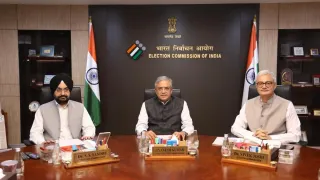
Amid the ongoing ECI-SIR row, the Election Commission of India (ECI) has issued a clarification on Form-6 to address concerns raised by existing voters whose names are missing from the draft electoral roll under the Special Intensive Revision (SIR) process.
The ECI has clarified that voters whose names were included in previous electoral rolls but are missing from the draft roll can submit Form-6 to get their names included again. Voters can submit Form-6 for inclusion without fear of prosecution under Section 31 of the Representation of the People Act, 1950.
Some voters were worried that they could face legal action for making a false declaration because Form-6 requires applicants to state that their names are being included in the electoral roll for the first time.
The Commission has now made it clear that existing voters can also submit Form-6 if their names are missing from the draft electoral roll.
In a communication dated November 3, 2026, addressed to the Chief Electoral Officers of all States and Union Territories, the Commission said that some previous voters were hesitant to submit Form-6 because of this requirement.
The electors are required to “furnish a declaration in the form stating that their name is being included for the first time in the electoral roll. Many such voters believe that submitting Form-6, despite their previous enrolment, would amount to making a false declaration and could render them liable for legal action.”
The Election Commission has clarified that the declaration required under Form-6 has been in force since August 1, 2022.
It has stated that voters whose names are missing from the draft electoral roll can submit Form-6 to get their names included in the final electoral roll by following the prescribed process.
ALSO READ: What Is Special Summary Revision Announced By EC In 17 States? How It Differs From SIR | Explained
The Commission has also said that such voters must apply for inclusion again under the SIR process or afterwards, even if their names were included in an earlier electoral roll.
The Commission has emphasised that “the submission of Form-6 in such circumstances is solely for inclusion in the electoral roll under the SIR or afterwards and is not, by itself, false merely because the elector was previously enrolled.”
The ECI further said that its clarification is in line with a Delhi High Court order in the case of Nilotpal Datta & Anr. versus Election Commission of India & Ors., decided on October 14, 2026.
In that case, an applicant who was already registered as a voter argued that submitting Form-6 would amount to making a false declaration.
The High Court said that the petitioners' concerns were misplaced and closed the case. It observed that the petitioners could submit Form6 if they wished, and their applications would be considered according to the law.
Following this, the Election Commission has directed that Electoral Registration Officers must not take action under Section 31 of the Representation of the People Act, 1950, against voters only because they were registered in an earlier electoral roll and submitted Form-6 during or after the SIR process.
However, this protection applies only if the voter is not already registered in another Parliamentary or Assembly Constituency and the declaration otherwise follows the law.
The Chief Electoral Officers have been asked to inform all concerned about this clarification and give it wide publicity in local languages through available media so that voters are aware of it.