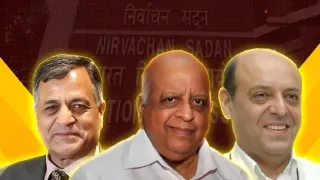
The Election Commission of India, a constitutional body, conducts elections in the country. The three-member body is expected to have a unified opinion on any decision. However, the question is whether the Election Commissioners have always been unanimous. The answer is no.
The controversy around Chief Election Commissioner Gyanesh Kumar reminds us that there as been incidents in past when members of the Election Commission have not been on the same page.
Election Commissioners Sukhbir Singh Sandhu and Vivek Joshi had flagged multiple issues, including deletion of names, in various states during the voter roll cleanup but the poll body was unanimous in its decisions related to the pan-India Special Intensive Revision of voters' list, officials claimed on Wednesday. The officials made the remarks in the wake of an Indian Express report that the two Election Commissioners had objected to the Election Commission's steps 14 times in 10 months amid the SIR.
This claim has caused a stir in political circles. The opposition is demanding the resignation of Chief Election Commissioner Gyanesh Kumar, while the BJP has hailed it as a sign of a healthy democracy.
This isn't the first time Election Commissioners have had differing opinions on an issue; such instances have surfaced many times before. The most serious allegation against TN Seshan, who redefined the powers of the Election Commission, is that he didn't even call his fellow commissioners for meetings.
Ashok Lavasa Had A Different Opinion In 2019
During the 2019 Lok Sabha elections, then-Election Commissioner Ashok Lavasa expressed differed opinion from the Election Commission's majority decision on Model Code of Conduct matters involving PM Modi and then-BJP president Amit Shah. On several occasions, the Election Commission, based on the majority, did not consider statements made by the politicians violations of the Code of Conduct, while Lavasa held a different opinion on those matters.
When this happened several times, he recused himself from meetings on matters related to the code of conduct, arguing that there was no point in attending meetings when his dissent was not accepted.
N Gopalaswami VS Navin Chawla
This was the first instance in the history of the Election Commission of India where the Chief Election Commissioner recommended the removal of a fellow Election Commissioner to the President. In 2009, when the then Chief Election Commissioner N Gopalaswami was accused of being biased towards a political party, a recommendation was sent to then President Pratibha Patil to remove Election Commissioner Navin Chawla.
TN Seshan VS MS Gill-GVG Krishnamurthy
In the 1990s, TN Seshan was the country's Chief Election Commissioner. In 1993, the President appointed two more members to the Election Commission, making it a three-member constitutional body. Seshan challenged the decision, and the matter reached the Supreme Court.
In July 1995, the Supreme Court, in its landmark judgment, stated that the Constitution envisages a multi-member Election Commission, and therefore, the Election Commissioners, along with the Chief Election Commissioner, have a crucial role in decision-making. If the three differ on an issue, the decision will be made based on the majority. This arrangement became the basis for disagreements within the Commission.
Gill and Krishnamurthy accused TN Seshan of not involving them adequately in the Commission's work. Seshan was even accused of not inviting his fellow Commissioners to Commission Meetings and making all decisions by himself.
(With Inputs From Deepak Gupta )