The Congress suffered a major setback 4-0 defeat in Karnataka's Legislative Council elections, losing all four seats to the BJP and its ally, the Janata Dal (Secular). The BJP retained three seats, while the JD(S) won the Bengaluru Teachers' Constituency from the Congress, leaving the ruling party without a single victory.
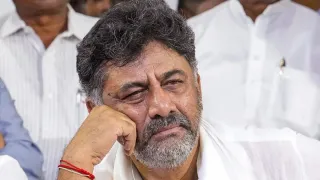
The outcome is a setback for Chief Minister DK Shivakumar, who, along with Karnataka Pradesh Congress Committee working president BK Hariprasad, ministers and senior party leaders, campaigned extensively across the constituencies. Despite the high-profile campaign, the Congress failed to secure even the one seat it had previously held.
Although the results are unlikely to affect the stability of the Congress government, but they have definitely strengthened the BJP-JD(S) alliance and given the Opposition a political and major boost ahead of the 2028 Assembly elections.
ALSO READ: Congress Wants Return To Ballot Paper But Lost Two Major Non-EVM Polls In A Month
Reacting to the defeat, Shivakumar said on Wednesday that the Congress would respectfully accept the people's verdict. Acknowledging that the party had fallen short of expectations, he said it had anticipated winning two seats but would now review the results, analyse the electorate's message and take corrective measures to strengthen its organisation.
But what went wrong for the Congress despite its extensive campaign? Here are four key factors which explain the party's defeat.
1. BJP-JD(S) alliance consolidated the Opposition vote
The BJP and JD(S) contested the elections with mutual support, combining their political strength against the Congress. Their coordination proved decisive, particularly in constituencies where the BJP already had an established support base.
The results also marked a uno-reverse of the alliance. In June, the Congress won five of the seven Legislative Council seats contested in Karnataka, with cross-voting by some BJP and JD(S) MLAs reportedly contributing to the outcome.
Four months later, the BJP and JD(S), came back together politically and won all four seats.
2. BJP retained its stronghold in three constituencies
The BJP maintained its dominance in the North-East Teachers', South-East Graduates' and West Graduates' constituencies. The Congress failed to overcome the party's established support among these seats.
In the North-East Teachers' Constituency, sitting BJP MLC Shashil G. Namoshi defeated Congress candidate Sharanappa Mattur by 3,297 votes. Namoshi secured 15,596 votes against Mattur's 12,299, marking his fifth victory from the constituency.
The constituency covers Kalaburagi, the home turf of AICC president Mallikarjun Kharge, and neighbouring districts in the Kalyana Karnataka region.
ALSO READ: Karnataka MLC Results 2026: BJP-JDS Alliance Wins Bengaluru, North-East Teachers’ Constituencies
In the South-East Graduates' Constituency, BJP candidate K M Suresh defeated Congress nominee Shashi Hulikunte Mutt by a decisive margin of 23,098 votes.
In the West Graduates' Constituency, sitting BJP MLC S V Sankanur defeated Congress candidate Mohan Limbikai by 9,323 votes. Sankanur secured 33,711 votes, while Limbikai received 24,388.
3. Congress lost even the Bengaluru Teachers' seat
The Congress's defeat in the Bengaluru Teachers' Constituency was particularly significant because the party lost the only seat it had previously held.
JD(S) candidate A P Ranganath defeated sitting Congress MLC Puttanna by a narrow margin of 908 votes. Ranganath secured 10,810 votes, while Puttanna received 9,902.
Puttanna, a five-time MLC, had switched from the JD(S) to the Congress ahead of the 2023 Assembly elections. His defeat highlighted the JD(S)'s ability to reclaim the constituency despite the Congress's efforts to retain it.
Losing this seat meant that the Congress failed to register a victory anywhere in the four constituencies.
4. Congress struggled to secure support among teachers and graduates
Unlike Assembly elections, Legislative Council elections from teachers' and graduates' constituencies are restricted to registered voters who meet specific eligibility requirements. The results therefore reflect the preferences of these specialised electorates rather than the broader voting population.
The Congress's failure to win any of the four seats suggests that its campaign did not secure into sufficient support among these groups.
Congress's electoral narrative faces fresh questions
The results come at a time when the Opposition is protesting against the Special Intensive Revision (SIR) of electoral rolls and demanding the resignation of Chief Election Commissioner Gyanesh Kumar over alleged irregularities in the electoral process.
The demand to return to ballot paper voting has also featured every time in the Congress's campaigns on electoral issues. The party has continued to raise concerns about electronic voting machines (EVMs) and electoral roll revisions.
However, the Karnataka Legislative MLC results tells a different narrative. The elections were conducted using ballot papers, yet the Congress failed to win a single seat. While the outcome alone does not settle broader questions about electoral fairness, it suggests that the party's performance must also be examined through factors such as candidate selection, voter outreach, organisational strength and alliance management.