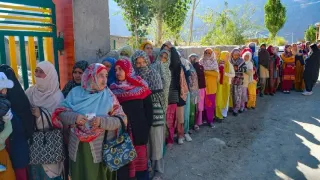
Jagran Correspondent, Jammu | Voting for the first municipal and panchayat elections in Ladakh after becoming a Union Territory in 2019 was underway on Saturday. These elections are not only limited to the selection of local representatives, but will also test the changing political landscape of Ladakh, the credibility of major parties, and the popularity of local leadership after being separated from Jammu and Kashmir.
For the BJP, Congress, and National Conference, these elections will not only be an opportunity to prove their political influence but will also determine the future course of politics in Ladakh.
ALSO READ: Sonam Wangchuk Claims House Arrest Day After Protest Over Leh Killings, Ladakh Council Elections
Leh and Kargil have different social and economic conditions. In Shia-dominated Kargil, the Congress, National Conference, and local religious-social organisations have held sway, while in Buddhist-dominated Leh, the competition has been primarily between the BJP and Congress.
These elections are also significant in terms of democratic representation and political acceptance.
Voting On 137 Sarpanch And 242 Panch Posts.
People will vote in 21 wards of the Leh Municipal Committee and 17 wards of the Kargil Municipal Committee. According to official figures, there are 2,720 registered voters in Leh and 645 in Kargil. Voting will take place from 8 am to 5 pm.
55 Sarpanches Elected Unopposed In Ladakh
In Ladakh, 55 Sarpanches were elected unopposed out of a total of 192 Panchayat constituencies, while voting will be held for 137 positions. Similarly, out of 1,428 Panch positions, 1,186 were elected unopposed, and elections will be held for 242 positions. The results will reveal rural voters' priorities on local issues such as water, roads, electricity, health, education, employment, pastures, and land, as well as the rural influence of political parties.
What's For BJP In Ladakh?
These elections hold special significance for the BJP in Ladakh. The party presents the 2019 decision to revoke Article 370 and create a separate Union Territory for Ladakh as a major achievement. However, in subsequent years, issues such as statehood, constitutional protections under the Sixth Schedule, land and employment rights, and local political participation became prominent. A movement has been launched under the leadership of the Leh Apex Body (LAB) to press local demands, including constitutional protections under the Sixth Schedule. Following last year's violent protests in Leh, local dissatisfaction with the BJP has only increased. The party will face the challenge of regaining the trust of voters.
Will The Political Equation Change In The Congress-NC Stronghold?
On the other hand, the Congress is viewing these elections as an opportunity to challenge the BJP's influence and demonstrate its strength on issues of local identity and constitutional rights. Congress's improved performance in Leh could signal the opposition's growing acceptance, while the BJP's victory would give it a psychological advantage for the upcoming elections.
The political dynamics of the contest in Kargil are different. The Congress and the National Conference have traditionally held strong support bases here. Political alliances between the two parties have been significant in recent years, but this time, their organizational strength and popularity will be tested in the different electoral circumstances.
How Effective Will Independent Candidates Be In Leh And Kargil?
The Congress faces the challenge of maintaining its influence, while the NC faces the challenge of establishing its political clout at the local level. A split in the vote between the two parties could create opportunities for the BJP and independent candidates. Given the importance of local issues and personal public relations, independent candidates could also influence the outcome.
The Leh Apex Body and the Kargil Democratic Alliance (KDA) also play a significant role in these elections. These organisations, which are agitating for statehood, constitutional safeguards, and local rights, have decided not to support any party or candidate. They will neither campaign for nor oppose any party. Their neutrality poses a distinct challenge to political parties.
(With Inputs from Naveen Sharma)