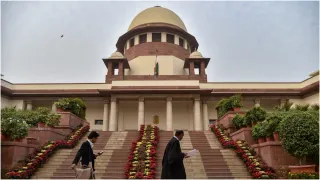
The Supreme Court on Wednesday referred the petition filed against the 2023 law removing the Chief Justice of India from the appointment process of the Election Commission to a 5-judge constitutional bench after a split verdict.
A Bench of Justices Dipankar Dutta and Satish Chandra Sharma differed on the Centre's request to refer the matter to a larger bench. Justice Dutta rejected the Centre's request for reference while Justice Sharma observed that the matter involved a substantial question that should be decided by a Constitutional Bench.
What did Justice Dutta observe?
During the hearing, Justice Dutta made a sharp observation of the 2023 law. He said that a Union minister, who replaced the CJI, is a nominee of the Prime Minister and cannot be expected to vote against him.
Dutta observed that prima facie, the 2023 law appears to confer a veto on the Executive as the panel failed the 'perception trust'. He added that the poll body must not only function as independent but appear independent too.
"Free and fair elections depend on a truly independent ECI. It is not enough for the ECI to be independent; it must appear to be independent. The member nominated by the Prime Minister cannot be expected to defy the Prime Minister," Justice Datta observed.
Invoking a cricket analogy, he explained that an umpire selected by a batting team will always be under a shadow of doubt, even if he makes a fair decision.
"Inclusion of Cabinet Ministers fails to provide an independent counterweight that a neutral selector would. It becomes largely ornamental," Justice Datta observed.
What did Justice Sharma say?
Justice Sharma, however, had a differing view of the matter as he argued that the issue has to be authoritatively determined by a Constitutional Bench in terms of Article 145(3) of the Constitution as there is a scope for a substantial question of interpretation.
ALSO READ: Mamata Banerjee Moves Supreme Court Against EC's Freeze On Trinamool Congress Name And Symbol
Even though there was a difference of opinion on the question of referring the matter to a larger bench, the bench unanimously decided to refer it to a 5-judge bench, instead of a 3-judge bench, as it could lead to unnecessary delays in deciding the matter.
"A decision by a three-judge bench on which of the two opinions is correct would be of little worth and only delay the decision on the significant issues that are raised," the bench observed in its unanimous order.