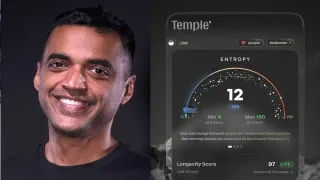
Zomato co-founder Deepinder Goyal's latest venture, Temple, the wearable startup, has been under fire as the medical fraternity questioned the scientific evidence. Temple's claims around brain blood flow, a proprietary physiological metric and insights into ageing drew severe criticism from a section of doctors.
The controversy has escalated into a public exchange between the Goyal and sections of the medical community, with prominent hepatologist Cyriac Abby Philips, popularly known as TheLiverDoc, accusing the company of making scientifically unsupported claims.
What Is The Controversy?
At the heart of the dispute is whether a wearable attached to the side of the forehead can reliably measure changes in blood circulation inside the brain, and whether the proprietary metrics it generates have been scientifically validated to support the broader health and longevity insights associated with the product.
What Are Doctors' Concerns?
The central objection is anatomical. Temple uses optical sensing (photoplethysmography) near the superficial temporal artery, which supplies the scalp and face.
Doctors, however, said the brain is supplied mainly through the internal carotid and vertebral arteries. According to doctors, scalp circulation can shift with exercise or temperature without reflecting flow inside the brain, and that one measurement site may not represent the whole brain.
Hepatologist Dr Cyriac Abby Philips has also called the product a "scam" and accused the company of misleading buyers. "His scam was caught in January 2026 after which he started calling out doctors rudely at that time also. He mentioned he will show the science of brain flow, Entropy assessment by the device at the time," Philips said in an X post.
Goyal has answered his critics on X. On motive and money, he said Temple has spent USD 30 million, including USD 20 million of his own. He argued that a scam would not recover a fraction of that from a few thousand sales.
Deepinder Goyal's Explanation
Goyal has pushed back, defending the technology, questioning the credentials and motives of some critics and insisting that Temple is "a fitness tracker and wellness device" and that it is "not a medical device". He asserted that the metrics still await clinical validation.
Temple, according to Goyal, is designed to continuously track physiological signals using sensors placed on the forehead.
Its two principal proprietary measurements are BrainFlow and Entropy. BrainFlow is intended to track relative changes in blood circulation associated with the brain. Goyal has described the device as capable of monitoring such changes continuously, rather than relying on occasional measurements in clinical settings.
Entropy, which Goyal has now identified as the product''s principal focus, is a proprietary score intended to indicate how hard the body is working to sustain itself. The score ranges from 1 to 250, with lower readings associated with deeper rest and higher readings with greater physiological exertion.
Goyal Defends High Price
The device, which uses optical sensors and is worn near the temple, opened for pre-orders in India on November 1 at Rs 85,000. Many questioned the high price of the device. On pricing, Goyal said if the Rs 85,000 price tag has upset people, he was sorry.
"There's a lot of work that went into Temple, and we priced it at what we think it's worth. If you think it's overpriced, you can wait for user reviews to decide if it's worth your money," Goyal said. He also said the product is initially not for Indian consumers, as he expects only 1% sales in the country.
(With PTI Inputs)