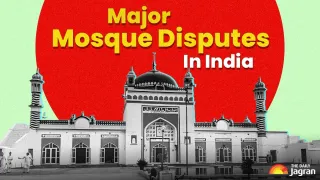
Amid preparations for Simhastha 2028 in Ujjain, the Madhya Pradesh High Court on Monday disposed of two appeals concerning Ujjain's Shahi Masjid after the mosque committee and the district administration reached an agreement over the portion of the structure affected by a road-widening project. The order came even as stone-pelting and clashes with the police were reported during the demolition exercise.
As tensions escalated, the police fired tear gas shells. Around noon, stone-pelting was reported again, following which the police resorted to a lathi charge. An FIR has been registered against 10 people in connection with the incident.
The Ujjain dispute is not an isolated case. In recent years, several mosques across India have been at the centre of legal disputes and administrative action over allegations of encroachment, ownership, religious claims or construction that allegedly did not conform to approved plans.
Here are some of the prominent mosque-related disputes that have reached the courts in recent years.
Shahi Jama Masjid, Sambhal
The Shahi Jama Masjid in Sambhal, Uttar Pradesh, has been at the centre of a major religious and legal dispute.
The centuries-old mosque stands on a raised mound in the city. The area around the mosque has both Hindu and Muslim residents, with majorly Hindu locality in front of its main entrance and a Muslim-populated area towards its rear.
The dispute intensified in 2024 after petitioners from the Hindu side claimed that a Harihar Temple once stood at the site where the mosque is located. In a petition filed before a Sambhal court, it was alleged that Mughal ruler Babur demolished the temple and constructed the mosque at the site.
On November 19, 2024, the court ordered a survey of the mosque. Five days later, on November 24, violence broke out in Sambhal during protests linked to the survey. The clashes led to deaths and injuries and triggered further legal proceedings.
The matter reached the Allahabad High Court and the Supreme Court. After hearing arguments from both sides, the Supreme Court has reserved its judgment. The dispute remains pending before the court.
Gyanvapi Mosque Dispute, Varanasi
The Gyanvapi dispute in Varanasi concerns the mosque located adjacent to the Kashi Vishwanath Temple.
Hindu petitioners claim that an ancient Kashi Vishwanath Temple once stood at the site and that Mughal emperor Aurangzeb ordered its demolition in 1669. They further claim that the Gyanvapi Mosque was subsequently constructed at the site or over portions of the earlier structure.
The Muslim side has maintained that the property is associated with the Waqf and that Muslims have offered prayers at the site for centuries.
An Archaeological Survey of India (ASI) survey was conducted pursuant to a court order. In its report, the ASI said that evidence indicating the presence of a pre-existing Hindu temple was found at the site. The findings have been disputed by the Muslim side.
Following a court order, Hindu devotees were permitted to offer prayers in the Vyas Tehkhana, a cellar within the Gyanvapi complex. The development led to heightened tensions in the area.
The dispute remains before the courts.
Shri Krishna Janmabhoomi-Shahi Idgah Dispute, Mathura
The Shri Krishna Janmabhoomi-Shahi Idgah dispute center arounds the Shahi Idgah Mosque in Mathura, Uttar Pradesh, which stands adjacent to the Shri Krishna Janmabhoomi temple complex.
Hindu petitioners claim that the mosque was constructed at the birthplace of Lord Krishna after an earlier temple was demolished during the Mughal period, and specifically attribute its construction to the reign of Mughal emperor Aurangzeb.
According to the Hindu petitioners, Shri Krishna was born in a prison at the site, which is traditionally identified with the Katra Keshav Dev area of Mathura. They claim that the Shahi Idgah Mosque occupies a portion of the 13.37-acre land associated with the Shri Krishna Janmabhoomi site.
Several lawsuits have sought various forms of relief, including the removal of the mosque and the restoration of control over the disputed land. The petitioners have also sought restrictions on access to the disputed site by Muslims.
The dispute remains before the courts.
Dhar Bhojshala Dispute
The Bhojshala-Kamal Maula complex in Dhar district, Madhya Pradesh, has also been the subject of a long-running religious and legal dispute. The Madhya Pradesh High Court declared the disputed Bhojshala-Kamal Maula complex a temple dedicated to Goddess Saraswati on May 15, 2026.
The Hindu side traditionally regards Bhojshala as an ancient temple dedicated to Goddess Saraswati and a centre of Sanskrit learning. The Muslim side refers to the structure as the Kamal Maula Mosque and asserts its religious rights over the site.
The dispute involves questions of history, archaeology, religious practice and legal rights. An Archaeological Survey of India (ASI) survey and report have also become central to the legal proceedings.
In January 2003, during Basant Panchami, tensions between Hindu organisations and the administration escalated into a major confrontation. Following a police lathi charge, protests intensified, and incidents of arson were reported at several locations.
Teele Wali Mosque, Lucknow
The Teele Wali Mosque in Lucknow is another site that has been involved in a historical and legal dispute. The mosque stands near the Gomti River, close to the Pakka Pul.
Hindu petitioners claim that the site was historically known as Lakshman Tila, or Sheshnag Tila. They allege that an ancient Hindu structure once existed at the site and was subsequently removed, after which the mosque was constructed.
The dispute has also involved petitions seeking permission to conduct Hindu worship at the site. The matter remains part of ongoing legal proceedings.