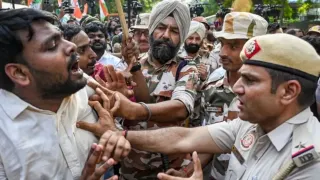
Jantar Mantar, one of Delhi’s prominent protest sites, is now reportedly off-limits for demonstrations. The development has raised questions about the legal consequences for individuals or groups who gather at the site to protest without permission.
The recent detention of Cockroach Janata Party (CJP) members Saurav Das and Ashutosh Ranka has brought the issue into focus, with questions being raised about the laws that apply to protests at Jantar Mantar and the possible penalties for violating restrictions.
CJP Members Detained After Attempting To Enter Jantar Mantar
Despite the restrictions, CJP members Saurav Das and Ashutosh Ranka reached Jantar Mantar on Tuesday and allegedly attempted to enter the premises by jumping over a gate.
ALSO READ: 'Kyun Desh Ko Kharab Kar Raha Hai?': Abhijeet Dipke Reaches Delhi, Passenger Questions Him | WATCH
Delhi Police detained the two for allegedly entering the site without permission. They were subsequently sent to five days of judicial custody.
Earlier, protesters seeking to hold demonstrations at Jantar Mantar were required to obtain written permission, including a no-objection certificate (NOC) from the Deputy Commissioner of Police, New Delhi district. The reported restrictions have now raised questions about the legal provisions applicable to demonstrations at the site.
What Punishment Can Protesters Face At Jantar Mantar?
The legal consequences depend on the nature of the alleged violation and the provisions invoked by the police. The laws cited in connection with such cases include:
- Disobeying a lawful order: Section 223 of the Bharatiya Nyaya Sanhita (BNS), corresponding to Section 188 of the Indian Penal Code (IPC), deals with disobedience to an order duly promulgated by a public servant. The punishment depends on the circumstances and the consequences of the disobedience.
- Unlawful assembly: Section 189 of the BNS, which replaced the relevant provisions of the IPC, deals with unlawful assembly. The punishment varies according to the alleged offence and the role of the individuals involved.
- Carrying weapons during an unlawful assembly: Participants carrying deadly weapons may face additional charges under the applicable provisions of the BNS, depending on the circumstances.
- Obstructing a public servant: Section 221 of the BNS addresses voluntarily obstructing a public servant in the discharge of public functions. Such an offence can attract imprisonment, a fine, or both.
ALSO READ: Jantar Mantar Row: Why Was Historic Site De-notified As Protest Site? Delhi Police Tells High Court
- Assaulting or using criminal force against police personnel: If protesters allegedly assault or use criminal force against a public servant to deter them from performing their duties, more serious charges may apply. The punishment depends on the specific offence registered and the facts of the case.
Can Protesters Be Arrested For Demonstrating At Jantar Mantar?
People who demonstrate in violation of a valid and applicable restriction may face police action, including detention or arrest, depending on the circumstances and the alleged offence. However, an arrest does not automatically mean that bail will be denied.
Whether an offence is bailable or non-bailable depends on the specific legal provision invoked. The applicable law, the circumstances of the incident and the court’s assessment determine the further course of action.