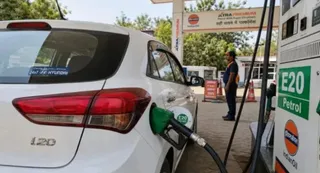
The Centre has strongly defended its ethanol blending policy in Parliament, stating that petrol prices in India would have touched Rs 125 per litre if ethanol had not been mixed with fuel when global crude oil prices surged to USD 135 per barrel.
According to the Ministry of Petroleum and Natural Gas, ethanol procured at government-fixed domestic prices helped consumers save around Rs 30 per litre during the Middle East crisis, keeping petrol prices at Rs 94.77 per litre.
The ministry explained that since 20 per cent ethanol (E20) is blended with petrol in India and ethanol is produced domestically at fixed prices, fluctuations in international crude oil prices had a limited impact on fuel costs.
It had earlier dismissed charges of diversions of food grains intended for the poor, or subsidised rice procured by the FCI, for ethanol blending.
Current Petrol Prices
Despite the outbreak of the war in the Middle East on February 28, 2026, the administration did not revise fuel prices for around 75 days and later hiked them by Rs 7.50 a litre in May.
Currently, the E20 petrol price is Rs 102.12 per litre in Delhi; on the other hand, the price of ethanol-free petrol is Rs 169 per litre.
Impact On Vehicle Mileage
Responding in the Lok Sabha, the Ministry of Road Transport and Highways said that using E20 petrol in BS-III, BS-IV and BS-VI vehicles originally designed for E10 fuel could reduce fuel efficiency by 2 per cent to 6 per cent.
Earlier, the Petroleum Ministry had estimated the mileage loss at 3 per cent to 5 per cent. Both ministries maintained that the ethanol blending programme has been implemented through a scientific and phased approach, supported by a gradual expansion of ethanol production capacity and the required infrastructure.
ALSO READ: ‘Still Under Testing, India Will Take Next Step Only After…’ Here’s What Govt Said On E-25 Petrol
Extensive Testing Before Rollout
Union Road Transport Minister Nitin Gadkari informed the Lok Sabha that automobile manufacturers and oil marketing companies were consulted before the rollout of E20 petrol.
He said the decision was taken only after extensive testing to assess engine durability, compatibility of vehicle components, and emission levels, ensuring that the fuel met technical and environmental standards.