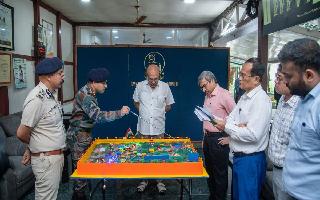
Manipur Chief Minister N Biren Singh on Sunday held a meeting with the officials of the Border Roads Organisation (BRO) to discuss plans to extend the India-Myanmar border fencing by 70 kilometres over the influx of illegal immigrants in Manipur from neighbouring Myanmar.
The Manipur CM’s meeting with the Chief Secretary and officials from the Border Roads Organisation (BRO), the state police and the Home Department comes a day after he requested the Centre to end the ‘free movement regime’ along the India-Myanmar border and complete its fencing.
Free Movement Regime (FMR) allows citizens living along the border on either side to travel up to 16 kilometres inside another country without any documents or visa.
Taking to X, formerly Twitter, the Manipur CM wrote, "Held a meeting with the officials of BRO and deliberated the plan to begin construction of an additional 70 km of border fencing along the Indo-Myanmar border. I was joined by Chief Secretary, DGP and officials from the Home Department.”
"In view of the rise in illegal immigration and drugs smuggling from the neighbouring country, safeguarding our porous borders has become an urgent necessity," he further added.
Manipur shares a 398-kilometer border with Myanmar, of which around 6 kilometres is fenced, news agency PTI reported citing officials.
ALSO READ: NIA To Seize Assets Of 19 Fugitive Khalistani Terrorists Spreading Anti-India Hate: Report
Earlier on Saturday, the chief minister emphasised that he government have to stay focused on issues including an influx of illegal immigrants, fighting massive poppy cultivation, and taking up welfare activities for internally displaced people.
The violent ethnic clashes erupted in Manipur on May 3. (Image: ANI)
More than 160 people have been killed ever since the ethnic clashes erupted in Manipur on May 3 after the tribals of the Kuki community attended a ‘Solidarity March’ to protest against the inclusion of the majority Meitei community in the ST category.