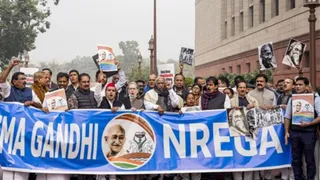
The Viksit Bharat-Guarantee for Rozgar and Ajeevika Mission (Gramin) (VB-G RAM G) Bill 2025 was passed in the Lok Sabha on Thursday amid fierce protests by opposition leaders, who tore a copy of the bill inside the House and accused the government of destroying the legacy of Mahatma Gandhi by removing his name from the scheme.
The VB-G RAM G bill aims to replace the UPA government's flagship rural employment scheme -- MGNREGA, which was enacted in 2005 under the Manmohan Singh-led government and guarantees 100 days of wage employment to rural households. Under the new bill, the minimum wage days have been increased to 125 days.
ALSO READ: Key Differences Between MGNREGA And VB-G RAM G Bill 2025
Responding to the opposition's criticism of removing Mahatma Gandhi's name, Rural Development Minister Shivraj Singh Chouhan defended the renaming of the bill and accused the opposition of deviating from Gandhi's ideals. Chouhan further asserted that the Modi government was ensuring that the ideals of Mahatma Gandhi were upheld through various initiatives taken by it.
"Bapu is our ideal, our inspiration. We are committed to following the ideals of Mahatma Gandhi Ji, which is why the Bharatiya Janata Party has incorporated Gandhi Ji's social and economic philosophy into its Panchnischay. The opposition is murdering Bapu's ideals. Yesterday in the House, I listened to the honorable members until 1:30 at night. You listen to your own words and don't listen to ours; this too is violence," he said.
"Congress killed ideals of Bapu, NDA ensured Bapu lives through pucca houses built under the PM Awas Yojana, Ujjwala yojana, Swachh Bharat Mission, Ayushman Bharat," Chouhan said.
The passage of the VB-G RAM G bill came a day after the Lok Sabha held a nearly 14-hour-long debate on the legislation on Wednesday. While the government pressed for its passage, asserting that it aims to align rural development with the Viksit Bharat 2047 vision, focusing on empowerment and growth to build a resilient rural Bharat.
However, the opposition members demanded that the legislation be referred to the Standing Committee or Joint Parliamentary Committee (JPC) for further scrutiny. Apart from calling it an insult to Mahatma Gandhi, opposition leaders, mainly Congress MPs, have alleged that the new legislation weakens MGNREGA's demand-driven guarantees, centralises decision-making and shifts costs to states.
"We will protest against this bill. With this bill, MGNREGA will end in the coming months. The moment the burden shifts to the states, this scheme will gradually end. This bill is against the poor," Congress MP from Wayanad, Priyanka Gandhi, said.
Viksit Bharat-G RAM G Bill, 2025: Key Provisions:
Replaces MGNREGA: A modern rural employment framework aligned with Viksit Bharat 2047.
Enhanced Employment: Guarantee 125 days of wage employment per rural household.
Focused Nature of Works: Four priority areas covering water security, rural infrastructure, livelihood infrastructure, and climate resilience.
Local planning with National Integration: Viksit Gram Panchayat Plans linked with national spatial platforms.
Support to Agriculture Pause in work for an aggregate of 60 days during peak sowing and harvesting seasons.
Predictable Funding Framework Shift to normative funding with a protected employment guarantee.
Strong Transparency and Oversight: AI-based monitoring, real-time dashboards and mandatory social audits.
Centrally Sponsored Structure: Shared Centre-State responsibility (60:40 for most states), shifting from MGNREGA's 100% central funding.
Unemployment Allowance: Retains a mandatory allowance if work isn't provided within 15 days, paid by the state.
Work Cycle: Includes a 60-day "no-work" period for peak farming seasons (sowing/harvesting) to support agriculture.
New Card and Penalties: Introduces a 3-year valid "Gramin Rozgar Guarantee Card" and higher penalties for violations.