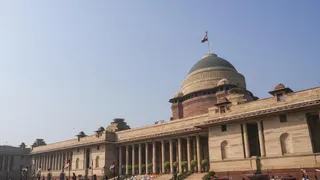
Following Prime Minister Narendra Modi's announcement on Sunday, February 22, to remove the bronze bust of Edwin Lutyens from the central courtyard of Rashtrapati Bhavan, President Droupadi Murmu unveiled the bust of C Rajagopalachari at Rashtrapati Bhavan today on Monday. This statue has been installed in place of Lutyens' statue. A monument dedicated to C Rajagopalachari, the first Indian Governor-General of independent India, now stands where the British architect’s statue stood for decades in the heart of the building he designed.
With the launch of ‘Rajaji Utsav,’ a week-long commemorative event and exhibition celebrating the life of the freedom fighter, which will continue until March 1. Addressing the nation, PM Modi emphasised that India is transitioning toward valuing symbols rooted in indigenous culture and service rather than colonial heritage.
The Architect: Edwin Lutyens And ‘Imperial Hybrid’
Edwin Lutyens, born in London in 1869. "Ned" was his childhood name. Edwin was never meant to be a globetrotting architect. A childhood survivor of rheumatic fever, was too delicate for university. He spent his youth in the Surrey countryside, "using his eyes instead of his feet" to learn the craft of building.
ALSO READ: HAL Issues Clarification On Reported Crash Of Tejas Fighter Jet, Says 'Minor Technical Incident'
Lutyens built his career on English country houses before being appointed chief architect for the massive undertaking of shifting the British Indian capital from Calcutta to Delhi following the 1911 Delhi Durbar. When the British decided to move their capital, Lutyens was given a blank canvas. He didn't just build a city; he built a statement. Alongside Sir Herbert Baker, he fused Western neoclassicism with Buddhist domes and Mughal arches, creating the Viceroy’s House, a building he personally designed, and where his own bust has sat until now..
The Political Moniker: Beyond The Map
Over the century, "Lutyens' Delhi" ceased to be a mere 26-square-kilometer postal zone. It became a political slur. To the current administration, the term represents a "disconnected elite", an Oxbridge-educated, English-speaking establishment that critics say is sealed off from the "real India."
By removing Lutyens’ statue, the government is signaling more than just a renovation; it is a symbolic strike against what PM Modi calls the "mentality of slavery."
Rajaji: The First Indian Governor-General
The new occupant of the central courtyard, C Rajagopalachari famously known as Rajaji, was a titan of the Indian independence movement and a close confidant of Mahatma Gandhi. His historical significance is unique; he remains the only Indian to have served as Governor-General, a position he held from 1948 until India transitioned into a republic in 1950.
Later in his career, Rajaji broke away from the political mainstream to found the Swatantra Party, advocating for classical liberal values in opposition to Jawaharlal Nehru's economic policies. PM Modi lauded Rajaji’s legacy, noting that he viewed leadership not as a status of power, but as a commitment to public service.