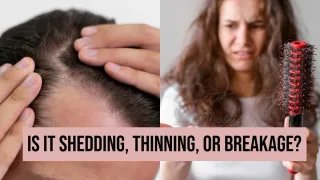
“Am I going bald, or did my brutal breakup three months ago just trigger a shed?" These are the common questions we start to ask the moment we see a large bunch of hair in the bathroom drain. While the situation may look alarming, Dermatologist Dr Ashwini Kandikatla explains that 50–100 hairs a day is normal human biology; losing 250 in a clump is not.
Hair can lose its fullness long before a noticeable bald patch appears. A parting that gradually widens, a hairline that begins to recede or strands that seem finer than before may signal a change in the way hair is growing.
According to Dr Kandikatla, "In the 20s and 30s, these signs are often associated with stress, busy schedules or seasonal shedding."
Shedding vs Thinning
The distinction between shedding and thinning is particularly important. If you're reading this while fishing a small rodent-sized clump of hair out of your bathroom drain, you are in trouble.
| Category / Condition | Definition / Description | Key Indicators & Triggers |
| Normal Shedding | Hair leaving the scalp as part of the natural growth cycle. | • Losing ~50–100 hairs a day • Varies daily; washing/brushing may reveal accumulated strands from prior days • Small amounts do not indicate a hair-loss condition |
| Progressive Thinning | Occurs when hair follicles produce increasingly fine strands over time. | May become more apparent in photographs or under bright lighting rather than during everyday styling. |
| Breakage | Happens when the hair shaft weakens and snaps before completing its natural growth cycle. | Noticeable as snapped or broken strands rather than whole hairs leaving the root. |
| Telogen Effluvium | A response where the body shifts more hair follicles into the resting phase of the growth cycle. | Triggers: High fever, surgery, childbirth, or substantial weight loss. Timing: Often becomes visible 2 to 3 months after the triggering event. |
| Hereditary Pattern Hair Loss | A genetic form of hair loss that develops progressively over time. | Men: Recession at the temples or thinning around the crown. Women: Widening part or reduced density across the top of the scalp. |
Dermatologist Dr Ashwini Kandikatla describes shedding as hair leaving the scalp, while progressive thinning can occur when follicles produce increasingly fine strands. Breakage presents another problem. It happens when the hair shaft weakens and snaps before the strand completes its natural growth cycle.
Losing approximately 50–100 hairs a day is considered part of the normal hair growth cycle. The amount of shedding can vary from day to day, and hair noticed during washing or brushing may include strands that have shed over the preceding days. Therefore, the number of hair seen at any one time does not necessarily indicate a hair-loss condition.
"After a high fever, surgery, childbirth or substantial weight loss, the body may shift more hair follicles into the resting phase of the growth cycle. This response, known as telogen effluvium, often becomes visible two to three months after the triggering event," Kandikatla says.
Hereditary pattern hair loss develops differently. Men may notice recession at the temples or thinning around the crown; women may see a widening part or reduced density across the top of the scalp. As the process progresses, changes may become more apparent in photographs or under bright lighting than during everyday styling.
ALSO READ: 5 Best Reasons To Avoid Combing Wet Hair To Prevent Hairfall
Why Age Is Only One Part Of The Picture
Hereditary thinning can begin in early adulthood, even when the change seems unexpected. Family history can offer useful insight into hereditary hair loss, although its absence does not necessarily mean that the condition is unrelated to genetics.
The distribution of thinning and the way it progresses are often more informative than age alone.
Dermatologist Insights: "Iron deficiency, thyroid disorders, certain medicines and significant dietary restriction can contribute to hair loss. In women, hair thinning along with irregular periods, persistent acne or increased facial hair may indicate a hormonal issue that needs medical assessment."
(Image: Magnific)
When Hair Care Becomes Part of the Problem
- There can be many reasons for hair thinning or shedding, especially in your 20s and 30s. Some of them are
- Tight slicked-back buns/hairstyles that can lead to traction alopecia
- Extreme caloric deficit lifestyle
- Repeated heat styling, chemical processing and rough handling
- Wrong products that are not suited for your hair porosity. [Know how to check your hair porosity here]
These can damage the hair shaft, leaving strands prone to breakage.
Bloodwork Checklist To Demand From A Doctor:
| Category | Test Name | Focus |
| Nutritional & Metabolic Markers | Serum Ferritin & Iron Panel | Checks iron stores; low ferritin is a common reversible cause of shedding (telogen effluvium) and thinning in women without full-blown anemia. |
| Vitamin D (25-Hydroxyvitamin D) | Evaluates vitamin D receptors, which play a critical role in hair follicle cycling and regeneration. | |
| Vitamin B12 & Folate | Essential for cellular energy and the rapid division of cells in hair follicles. | |
| Zinc | A vital mineral required for hair tissue growth and repair; deficiencies lead to structural weakness and shedding. | |
| Thyroid Function Tests | Thyroid-Stimulating Hormone (TSH) | Screens for overall thyroid performance. |
| Free T3 and Free T4 | Evaluates active thyroid hormones; both underactive and overactive thyroids disrupt the hair growth cycle and cause diffuse thinning. | |
| Hormonal Panels | Total and Free Testosterone | Evaluates androgen levels, impacting the miniaturization of hair follicles. |
| Dehydroepiandrosterone Sulfate (DHEAS) | An adrenal hormone test useful in assessing excess androgens. | |
| Sex Hormone-Binding Globulin (SHBG) | Helps determine the proportion of free, active androgens in the bloodstream. | |
| Prolactin | Evaluates elevated levels that can sometimes contribute to hair shedding and hormonal shifts. | |
| Inflammatory & Systemic Markers | Complete Blood Count (CBC) | Checks for underlying infection, inflammation, or anemia by measuring red and white blood cells. |
| Antinuclear Antibodies (ANA) | A screening test used if an autoimmune condition (such as lupus) is suspected of triggering sudden or patchy hair loss. |
When To Seek A Dermatologist’s Advice
Dr Ashwini Kandikatla explains that a temporary increase in shedding after illness or another identifiable trigger may improve with time. "Progressive thinning or unexplained shedding that persists deserves closer attention. Sudden bald patches, scalp pain, redness or marked scaling should also be assessed promptly."
The challenge is to understand why hair density is changing rather than focus only on the number of strands shed. Early assessment can help distinguish temporary shedding from progressive hair loss and guide appropriate management.
ALSO READ: Winter Hair Fall: Expert Explains Causes Of Seasonal Hair Loss And How To Handle It
FAQs
Q1. What is the difference between hair shedding, thinning, and breakage?
A1. Shedding is hair leaving the scalp, while thinning happens when hair follicles produce increasingly fine strands over time. Breakage happens when the hair shaft weakens and snaps before completing its natural growth cycle.
Q2. How many hairs are normal to lose in a day?
A2. Losing approximately 50 to 100 hairs a day is considered a normal part of the hair growth cycle.
Q3. When should you see a dermatologist or specialist for hair loss?
A3. Consult a medical professional if you notice sudden, patchy hair loss; a widening part; rapid daily shedding that persists for more than a few months; or visible scalp irritation and scaling.