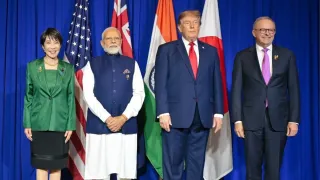
The seventh Quad Leaders’ Summit, held in Manila this week on the sidelines of the ASEAN-related summits, marks an important moment in the grouping's evolution.
Bringing together US President Donald Trump, Indian Prime Minister Narendra Modi, Australian Prime Minister Anthony Albanese and Japanese Prime Minister Sanae Takaichi, it was the first leaders-level meeting in more than two years and the first attended by Trump in his current term.
Against the backdrop of uncertainty following the cancellation of the anticipated 2025 summit in India, the meeting reaffirmed the Quad’s continuing relevance as a platform for strategic coordination among four major Indo-Pacific democracies.
Coinciding with nearly a decade since the grouping’s revival and the tenth anniversary of Shinzo Abe’s Indo-Pacific vision, the Manila summit reiterated the commitment to a free, open, peaceful and prosperous Indo-Pacific, while seeking to reposition the Quad as a “force for good and a partnership of action” focused on translating strategic convergence into tangible outcomes.
The most significant outcome of the summit was the announcement and advancement of a series of initiatives intended to translate strategic convergence into practical cooperation.
The Manila summit advanced five key initiatives that reflect the Quad's expanding strategic and economic agenda. The inaugural Quad Business Leaders’ Forum, to be hosted by India in Mumbai in early 2027, seeks to deepen commercial partnerships, attract investment and strengthen regional supply chains, offering New Delhi an opportunity to position itself as a key economic partner in the Indo-Pacific.
The Indo-Pacific Maritime Surveillance Collaboration (IPMSC) will enhance information sharing and maritime domain awareness, including through a proposed joint exercise involving the four countries’ P-8 and P-3C patrol aircraft in March 2027.
The Super Intelligence Accelerator, backed by over $85 million, seeks to expand access to trusted AI technologies and technical assistance across the region, highlighting the growing centrality of technological cooperation.
Meanwhile, the Quad Partnership for Cable Connectivity and Resilience, including Australia's expanded contribution towards undersea energy cables, aims to strengthen critical infrastructure and regional connectivity.
Enhanced cybersecurity cooperation further seeks to address growing digital vulnerabilities and promote a secure cyberspace. Collectively, these initiatives underscore the Quad’s transition towards a more comprehensive partnership linking maritime security with economic resilience, critical infrastructure and emerging technologies. Although China was not explicitly named, the strategic context of the summit was unmistakable.
The leaders expressed concern over economic coercion, arbitrary export restrictions and unilateral attempts to alter the status quo through force or coercion, while emphasising maritime security, resilient supply chains and critical minerals cooperation.
The deliberate absence of a direct reference to Beijing reflects the Quad’s continued preference for strategic ambiguity, allowing the four countries to deepen coordination without defining themselves as an explicitly anti-China coalition. This is particularly important for India, which seeks to strengthen its strategic partnerships while preserving its strategic autonomy.
The growing emphasis on critical minerals and supply-chain resilience also underscores how economic security is becoming inseparable from traditional security concerns.
The unequivocal condemnation of terrorism, including cross-border terrorism, is significant for New Delhi, while the reaffirmation of ASEAN centrality and secure maritime corridors reflects the Quad's effort to embed its strategic objectives within a broader regional framework.
The Manila summit demonstrated the Quad’s ability to withstand changes in political leadership and divergent strategic priorities, dispelling some of the uncertainty surrounding its future under Trump, particularly after the cancellation of the anticipated 2025 leaders’ summit.
The underlying strategic logic of the grouping remains compelling, even as its agenda is being recalibrated to reflect the Trump administration's preference for tangible outcomes, with greater emphasis on commercial partnerships, critical minerals, technological cooperation and supply-chain resilience.
Nevertheless, differences in threat perceptions, economic priorities and approaches towards China remain, as reflected in the relatively less explicit language on the South and East China Seas.
The Quad, therefore, is unlikely to evolve into a formal military alliance; its enduring strength lies in its flexibility and ability to accommodate divergent national interests within a broader framework of strategic convergence.
For India, the Manila summit offers both strategic reassurance and an opportunity to shape the Quad’s evolving agenda. New Delhi's preference for a flexible grouping that advances a free and open Indo-Pacific without becoming a formal military alliance is broadly reflected in the outcomes.
Hosting the inaugural Quad Business Leaders’ Forum allows India to link its strategic partnerships with economic priorities, particularly manufacturing, critical minerals, technology and supply-chain diversification. Maritime surveillance cooperation and undersea cable connectivity are equally significant for India's interests in the Indian Ocean, strengthening maritime domain awareness and the resilience of critical infrastructure.
The choice of Manila as the venue, alongside the reaffirmation of ASEAN centrality, also reinforces India’s preference for an inclusive Indo-Pacific architecture in which the Quad complements, rather than displaces, existing regional institutions.
The Manila summit reaffirms the Quad’s continuing relevance amid intensifying strategic competition, economic fragmentation and technological uncertainty in the Indo-Pacific. Its significance lies not in reiterating familiar principles but in advancing practical cooperation through maritime surveillance, business partnerships, undersea cable connectivity, cybersecurity and artificial intelligence.
However, the real test will be implementation, with sustained political commitment, adequate resources and meaningful regional engagement essential to translating these initiatives into tangible outcomes.
The Quad is neither retreating nor remaining static; rather, it is adapting to an environment in which economic security, technological competitiveness and maritime stability are increasingly interconnected.
For India, this evolution offers an opportunity to deepen strategic partnerships while preserving its strategic autonomy. Ultimately, the grouping’s future relevance will depend on its ability to move beyond geopolitical signalling and deliver a more secure, resilient and prosperous Indo-Pacific.
(Note: The writer is the Vice President at the Observer Research Foundation.)