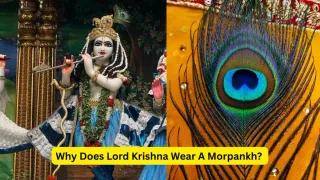
Janmashtami is just around the corner, and devotees have already come in the spirit to celebrate the birth of Lord Krishna. Whenever Lord Krishna is depicted in an idol or image,he is often seen carrying a flute in his hand and a peacock feather in his hair. These ornaments are not ordinary. They carry deep spiritual meaning. Let's understand in detail what the peacock in Lord Krishna's hair signifies.
What Is The Mythological Story Behind Krishna's Morpankh?
According to Hindu scriptures, Lord Krishna was once playing his flute in the woods of the holy place Vrindavan. As the melody of the flute rang, it created a soothing, calm atmosphere around the forest. That sound attracted the peacocks, who gathered around Lord Krishna and started to sing and dance with joy. Seeing them dancing, Lord Krishna also joined their celebration.
The peacocks danced till they were exhausted, but Lord Krishna continued to dance for days. When he finally stopped dancing, a mesmerising peace was witnessed in the surroundings of Vrindavan. The peacocks, overjoyed and grateful, offered their feathers to Lord Krishna.
Lord Krishna gracefully accepted the offering and put it in his turban. From that day onwards, Lord Krishna decided to wear peacock feathers on his head.
Lord Krishna is often seen carrying a flute in his hand and a peacock feather in his hair (Image: Pexels)
ALSO READ: Where To Keep A Crystal Tortoise At Home? Vastu Tips And Benefits Explained
What Is The Significance Of Krishna's Peacock Feather?
Lord Krishna's peacock feather is believed to hold immense spiritual and religious importance. Here's how:
1. The Peacock Feather Represents Sattva – Purity, Beauty And Harmony
In the Bhagavata Purana, peacocks are described as symbols of sattva, the quality of purity and divine harmony. Lord Krishna wearing a peacock feather on his head is believed to represent his mastery over senses and his purity despite worldly chaos.
2. The Feather Stands For Nature’s Surrender To The Divine
The feather is believed to symbolise nature’s surrender to the divine. It also emphasises Lord Krishna's connection to the environment and his role as the preserver of the universe.
3. Unwavering Devotion And Surrender To Lord Krishna
According to Hindu beliefs, the feathers are believed to absorb poison and transform negative energies into virtue and wisdom. In the same way, a devotee, through surrender and devotion to Lord Krishna, can transform their negative qualities into spiritual virtues.
4. Symbol of Radha's Eternal Love
The peacock feather is also believed to symbolise Lord Krishna's eternal love and devotion to Radha. According to mythology, Radha gave Lord Krishna a peacock feather as a souvenir to remember her.
The peacock feather is also believed to symbolise Lord Krishna's eternal love and devotion to Radha (Image: Pexels)
5. Symbol of Happiness And Good Fortune
The strong, vibrant combination of green, golden, blue, red, and other colours of the peacock feather is believed to release a holy energy and a sense of purity that attracts wealth and good fortune.
ALSO READ: 50+ Osho Quotes That Offer A New Perspective On Life, Love, Meditation And Happiness
Thus, Lord Krishna's feather is not just an ordinary ornament. It is a spiritual statement too. It reminds devotees to stay humble and modest. It also conveys the message that the divine is never far away; it is present in our daily lives.
FAQs
1. Why does Lord Krishna wear Morpankh?
Lord Krishna wears peacock feather to show his gratitude towards the peacock who offered him his feathers.
2. What does peacock feather represent?
According to Hindu beleifs, peacock feathers conveys the message that the divine is never far away; it is present in our daily lives.