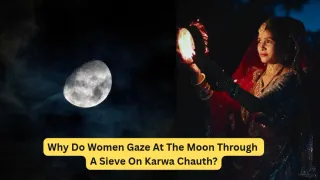
During Karwa Chauth, as the evening approaches and the Moon rises, a woman dressed in festive red, holding an earthen lamp and sieve, gazes at the moon and then turns it towards her husband's face.
Though the ritual is romantic, cinematic and deeply sacred carry immense spiritual significance and has its roots in legend of Queen Veeravati.
It is believed that seeing the moon through a sieve filters out negativity, bringing long life and pure devotion.
Let’s understand why looking at the moon holds immense significance on Karwachauth.
The Mythological Connection Behind This Practice
According to legend, Queen Veeravati, the only sister among seven brothers, observed a strict nirjala first Karwa Chauth fast at her maternal home.
As the evening approached, her body grew weak, and she fainted due to hunger and dehydration. Unable to see their sister’s pain, the brothers made a plan to help her break the fast without incurring divine wrath.
One brother climbed a tall peepal tree holding a mirror and a brass sieve before a raging fire. From the courtyard below, it created an illusion of a glowing moon.
Queen Veeravati, unknown to this broke her fast by looking at the fake moon. The moment she swallowed the food, she got the news that her husband, the King, had suddenly fallen ill.
Veeravati then realised she had broken her fast to a false moon. To restore her husband's health, she performed intense tapasya with extreme devotion. During the subsequent Karwa Chauth, Yama (the god of death) restored her husband to life.
Ever since, women view the moon through a fine sieve to ensure they are not deceived by illusions, mirrors, or artificial flares before breaking their penance.
ALSO READ: Born With Six Fingers? What Samudrik Shastra And Vedic Tradition Say
During Karwa Chauth, a woman dressed in festive red, holding an earthen lamp and sieve, gazes at the moon (Image: Pexels)
Spiritual Significance Of Looking At The Moon Through Channi
1. Filter Out the Impurities
The sieve acts as a psychological and spiritual metaphor to filter the rays. It is said that the moonlight on Kartik Chaturthi carries intense spiritual energy. Gazing directly at it after a day of fasting can be overwhelming.
So, the sieve diffuses and softens the moonlight, ensuring cooling and peaceful vibrations reach the eyes.
The sieve acts as a psychological and spiritual metaphor to filter the rays (Image: Pexels)
2. Filters Human Flaws
When the married woman sees the moon through the sieve and then shifts her gaze through the same sieve toward her husband, the act symbolises intentional perspective.
This act symbolically filters out marital flaws, grievances, and daily friction.
Correct Method To Perform The Sieve Ritual
Here are the few steps that one should follow while performing the sieve ritual:
1. The woman should first pour water toward the moon using a small brass pitcher (lota).
2. Then place a small lit ghee diya on the edge of the sieve.
3. After placing it, raise the sieve to their eye line, and then look directly at the moon through the wire mesh.
4. Then, after looking at the moon for a few seconds, shift the focus and gaze at their husband looking through the same mesh.
5. Then, using the lota filled with water, the husband should offer it to his wife, followed by a sweet to break the fast.
ALSO READ: What Is Maun Vrat? The Ancient Practice Of Silence For Modern Inner Peace
Thus, looking at the moon through the sieve during the ritual of Karwa Chauth invites positive energy and filters out the negative energy.
FAQs
1. Can you perform Karwa Chauth without a sieve?
While the sieve is the dominant North Indian tradition, regional communities simply view the reflection of the moon in a brass thali filled with water, oil, or milk. The sieve is customary, not strictly mandatory.
2. Why is a diya placed inside or near the sieve?
The earthen lamp acts as a beacon of warmth and light. Spiritually, it ensures that when looking through the sieve, the observer's vision is illuminated by purity, cancelling out shadows and doubt.
Karwa Chauth 2026 sieve tradition, why look through sieve Karwa Chauth, Veeravati story chhalni, Karwa Chauth moonrise ritual meaning