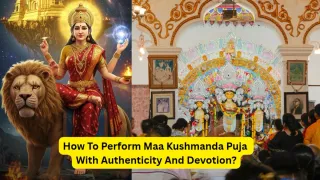
The fourth day of the auspicious Navratri festival is dedicated to worshipping Goddess Kushmanda, the fourth form of Navadurga believed to bring light, cosmic balance, and life to the universe.
Maa Kushmanda's name reveals her essence: Ku meaning ‘little,’ Ushma meaning ‘warmth’ or ‘cosmic energy,’ and Anda meaning ‘the cosmic egg.’
She resides in the core of Surya Mandala (the Sun), and worshipping her awakens the Anahata (heart) chakra, eliminating chronic illnesses, sorrow, and despair while granting abundance.
Let's understand the auspicious timings, significance, puja vidhi, mantra and special offering related to Maa Khushmanda.
Sacred Attribute | Ritual Detail |
Sharad Navratri 2026 Date | October 14, 2026 |
Goddess | Maa Kushmanda (4th Manifestation of Navadurga) |
Associated Planet | Surya (Sun) |
Ruling Chakra | Anahata (Heart Chakra) |
Sacred Colour of the Day | Royal Blue (Stimulates vitality and spiritual richness) |
Traditional Bhog | Malpua (Sweet flaked pancakes cooked in pure ghee) |
Favourite Flower | Red Hibiscus or Japa Pushpa, or Yellow Marigold |
Navratri Day 4: Date And Auspicious Timings
Day 4 of Sharad Navratri is on October 14, 2026, which corresponds to Chaturthi and Kushmanda puja. According to Drik Panchang, the auspicious timings for the puja rituals are:
Chaturthi Tithi begins: October 13, 2026, at 11:29 PM
Chaturthi Tithi ends: October 15, 2026, at 1:13 AM
Brahma Muhurta: October 14, 2026, 04:41 AM to 05:31 AM
Rahu Kalam (Inauspicious Time): October 14, 2026, 12:07 PM to 01:33 PM
Who Is Maa Kushmanda? Significance And Cosmic Legend
According to Hindu mythology, before the universe came into existence, darkness surrounded it. Maa Kushmanda, with her radiant smile, illuminated the darkness and gave birth to the Brahmanda (the universe).
She resides in the core of Surya Mandala (the Sun), providing life-giving cosmic light and warmth to all realms.
Maa Kusmanda is depicted with eight hands, called Ashtabhuja Devi, holding a bow, arrow, lotus,kamandal, mace, discus, and rosary. The kamandal and the jar of honey symbolise her role as a healer.
She mounts a tiger or lion, symbolising fearlessness, dharma, control over ego, and strength. Devotees believes that by worshipping her cures physical ailments, removes grief, and restore vital energy.
Maa Kushmanda is depicted with eight hands, called Ashtabhuja Devi (Image: Instagram/aiartera)
Maa Kushmanda Mantras
1. Prarthana Mantra
सुरासम्पूर्णकलशं रुधिराप्लुतमेव च
दधाना हस्तपद्माभ्यां कूष्माण्डा शुभदास्तु मे
Surāsampūrṇakalaśaṁ Rudhirāplutameva Cha
Dadhānā Hastapadmābhyāṁ Kūṣmāṇḍā Śubhadāstu Me
Meaning: May Maa Kushmanda, holding nectar-filled pots in her lotus hands, bestow auspiciousness, grace, and prosperity upon me.
2. Pranam Mantra
ॐ देवी कूष्माण्डायै नमः
Om Devi Kushmandayai Namah
3. Stuti
या देवी सर्वभूतेषु माँ कूष्माण्डा रूपेण संस्थिता।
नमस्तस्यै नमस्तस्यै नमस्तस्यै नमो नमः॥
Ya Devi Sarvabhuteshu Maa Kushmanda Rupena Samsthita
Namastasyai Namastasyai Namastasyai Namo Namah
ALSO READ: Why Are Women Traditionally Not Allowed To Visit Temples During Periods?
Puja Vidhi: Step-by-Step Worship Guide For Day 4
To perform Maa Kushmanda puja correctly at home, here are some steps that are traditionally followed:
1. Devotees should wake up early during the Brahma Muhurat, bathe and wear clean clothes (preferably Royal Blue).
2. Then clean the puja altar using Gangajal. Make sure that the Akhand Jyot and the Kalash established on Day 1 remain undisturbed.
3. Then place the idol or image of Maa Kushmunda on the platform and then apply fresh chandan, kumkum, and akshat. Offer red hibiscus or seasonal yellow flowers.
4. Then light a pure desi ghee diya and incense; wave them gently around the idol and then in the atmosphere.
5. Offer freshly prepared Malpua or pumpkin sweet to the Goddess. It is believed that offering this sweet pleases her.
6. Then chant the Om Devi Kushmandayai Namah mantra 108 times using a Rudraksha or Kamal Gatta mala.
7. Conclude the worship by performing the Durga Aarti with camphor, followed by a prayer asking forgiveness for any unintentional mistakes.
8. Then distribute the bhog among family and the underprivileged after the puja.
Conclude the worship by performing the Durga Aarti with camphor (Image: Pexels)
What To Offer Maa Kushmanda On Day 4
Traditionally, offering Malpua to Maa Kushmanda on Day 4 is considered auspicious. According to Devi Bhagavata Purana, offering Malpuas pleases the solar essence.
It is believed that offering this as bhog removes intellectual dullness and chronic ailments. If Malpua cannot be made, devotees can also offer pure honey, jaggery, or ash gourd (petha).
Navratri Day 4 Colour
The dedicated colour for the fourth day of Navratri is Royal Blue. Royal Blue symbolises depth, authority, mental serenity, and cosmic expansion. Wearing this colour on the fourth day helps devotees align with the cosmic energy which Maa Kushmanda radiates.
ALSO READ: 5 Powerful Durga Mantras Traditionally Chanted For Protection
Worshipping Maa Kushmanda on the fourth day of Navratri is a beautiful way to invite solar energy and good health into life.
FAQs
1. Which planet is ruled by Maa Kushmanda?
Maa Kushmanda governs the Sun. Astrologically, devotees with a malefic Sun in their birth chart worship her to remove obstacles, lack of confidence, and heart or eye problems.
2. Can fasting devotees eat Malpua?
Traditional Malpua is made of refined flour, which is not suitable for Navratri vrat. Devotees fasting on this day should prepare vrat-friendly Malpua using rajgira flour, singhare ka atta, mashed bananas, milk, and sugar or jaggery, cooked in pure desi ghee