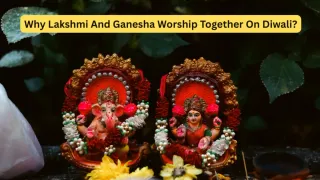
If you notice, on Diwali, Goddess Lakshmi and Lord Ganesha are worshipped together, not Lord Vishnu, even though he is her divine consort. The reason is that Goddess Lakshmi considers Lord Ganesha her son.
When a devotee worships them together on Diwali, it becomes a complete blessing: wealth (Lakshmi) guided by wisdom (Ganesha). Without wisdom, wealth can be lost quickly or misused, while wisdom without purpose can remain unfulfilled.
Let's understand the mythological and spiritual significance behind this pairing during Diwali.
Mythological Story Behind Goddess Lakshmi And Lord Ganesha Worship
According to the Shiva Purana and ancient folklore, Goddess Lakshmi once became proud of her wealth and prosperity and told Lord Vishnu that she was one of the most worshipped deities.
To break her ego, Lord Vishnu decided to teach her humility. He told Goddess Lakshmi that she might have everything in the world, but a woman is incomplete without motherhood.
Hearing this, Goddess Lakshmi became upset, and she went to Goddess Parvati for help. Seeing Goddess Lakshmi stressed, Goddess Parvati offered her son, Lord Ganesha.
Moved by this act, Goddess Lakshmi then declared, 'From this day forward, Ganesha is my spiritual son. All my wealth and prosperity will belong to him. Anyone who seeks my blessings for wealth must first worship Ganesha. If someone worships me without worshipping Ganesha first, I will not abide in their home.’
That is why, during Lakshmi Pujan, Lord Ganesha is prayed to first and placed on the right side of his mother, Goddess Lakshmi, as her son.
Goddess Lakshmi considers Lord Ganesha her son (Image: Pexels)
Spiritual Significance Of Worshipping Goddess Lakshmi And Lord Ganesha
Beyond mythology, worshipping Goddess Lakshmi and Lord Ganesha on Diwali carries a profound psychological and spiritual meaning:
1. Wealth Without Wisdom Leads To Destruction
Goddess Lakshmi represents prosperity, while Lord Ganesha represents wisdom and knowledge. Worshipping them together on Diwali teaches that for wealth accumulation, wisdom and intellect are needed; otherwise, it can be easily misused or lost quickly.
2. Obstacle Removal Before Prosperity
Lord Ganesha is also known as Vighnaharta, the remover of obstacles. So, to invite Goddess Lakshmi into your home, you first need to remove obstacles mental, physical, and karmic hurdles from your path.
3. The Four Goals Of Life
In Hindu philosophy, four goals of life need to be balanced: Dharma, Artha, Kama, and Moksha. Lord Ganesha governs Dharma and Buddhi, ensuring wealth should be earned through ethical means.
Goddess Lakshmi represents prosperity, while Lord Ganesha represents wisdom (Image: Pexels)
ALSO READ: Goddess Lakshmi Presses Lord Vishnu’s Feet: Know The Meaning Behind This Padasevana Tradition
Where Is Lord Vishnu On Diwali?
Diwali falls when Lord Vishnu is in Yogna Nidra, cosmic sleep. He is believed to awaken on Dev Uthani Ekadashi, which comes after Diwali.
So, instead of directly worshipping Lord Vishnu on Diwali, he is celebrated through Lord Rama (an avatar of Lord Vishnu).
How To Worship Lord Ganesha And Goddess Lakshmi On Diwali?
To worship Lord Ganesha and Goddess Lakshmi correctly, always place Lord Ganesha to the left of Goddess Lakshmi, symbolising his status as an adopted son.
Always chant prayers to Lord Ganesha first to clear negative energy before inviting Goddess Lakshmi's blessings into your home. After this, pray for Shubh-Labh. Lord Ganesha brings the Shubh; Lakshmi brings the Labh.
ALSO READ: Why Are Goddess Lakshmi’s Footprints Drawn During Diwali? Meaning, Direction And Mistakes To Avoid
Lord Ganesha and Goddess Lakshmi are worshipped together on Diwali to honour the bond between the two and remind devotees that wealth cannot be attained without wisdom.
FAQs
1. Is it wrong to worship Lord Vishnu on Diwali?
Traditionally, Diwali centres on Lord Ganesha puja; Vishnu is always revered in Hinduism. Diwali focuses on specific energies (wealth, wisdom) associated with Lakshmi and Ganesha, rather than a slight Vishnu.
2. Are there regional variations in Diwali worship practices regarding these deities?
Some regions may have slightly different customs, but the Lakshmi-Ganesha pairing remains dominant for Diwali in most Hindu traditions.
3. What are the specific offerings made to Lakshmi and Ganesha during Diwali?
Common offerings like sweets, flowers, fruits, and money are made to Lakshmi and Ganesha during Diwali