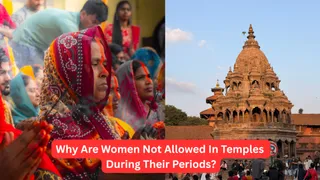
‘Don't visit the temple during your periods’, ‘Don't enter the kitchen’, and ‘Don’t participate in the puja while menstruating.’ These are the most common instructions given to a woman in India as she grows up. In many parts of India, the menstrual cycle is considered 'impure' or 'dirty'. Similar restrictions have also existed in several other religions and cultures, where menstruating women are barred from participating or getting involved in puja-related rituals because they are considered dirty.
This belief has been practised for centuries. But have you ever wondered why women are forbidden from visiting religious places or are not allowed to do certain things during their period? Let's understand the spiritual significance behind this practice.
Why Women Are Not Allowed In Temples During Their Period?
Menstruation is a natural biological process in which the body sheds the uterus lining. According to Hindu scriptures, Angirasa Smriti and Vashishta Dharmasutra, women are advised to hold their work and resume it after their periods, as the body is believed to require rest and should avoid physical exertion during this time.
As per Ayurveda, menstruation is believed to be associated with the body’s doshas. Doshas are considered to be bioenergies that make up every individual and help regulate different physiological functions in the body. There are primarily three doshas in our body, vata, pitta and kapha, which basically relate to the elements of air, fire and water, respectively.
Each dosha has a primary function in the body. Vata (air) is responsible for communication and perception; Pitta (fire) is responsible for metabolism; and Kapha (water) is the force of stability.
During periods, vata is the most active dosha. Apana vayu, one of the subtypes of the vata dosha, is responsible for the downward movement of energy, including the menstrual flow. According to this belief, any activity that interferes with this should be avoided.
It is also believed that during menstruation, women are receptive to the energies surrounding them. During puja and mantra chanting, the spiritual energy is believed to go upwards, whereas the menstrual energy flows downwards. According to this belief, these opposing energies can bring discomfort to the body. That is why women are often not allowed in the temples.
Doshas are considered to be bioenergies that help to regulate different physiological functions in the body (Image: Facebook/kayakalpalampur)
Spiritual Belief Related To Menstruation
Another traditional belief states that the temple contains a powerful presence of Prana (life force or spiritual energy) that exists in the idols. It is believed this energy affects the subtle body changes of the devotees. According to some traditions, this creates an imbalance of energy between the menstruating women and the deity. It is believed that this disturbance can harm the spiritual balance of the temple.
In India, these restrictions were originally associated with spiritual beliefs and the idea of allowing women to rest. However, with time, these beliefs evolved differently across different regions and cultures. While some parts of India celebrate menstruation as the symbol of fertility and creation, others continue to treat it as a taboo.
The belief can even be explained by taking the example of Sabrimala Temple, where women of menstruating age have traditionally been restricted from entering. One explanation can be the temple's unique spiritual discipline and the belief that the deity's powerful energy should remain undisturbed.
Another widely held traditional belief is that Lord Ayyappa is worshipped as a Naishtika Brahmachari (an eternal celibate). Since menstruation is associated with fertility, some devotees believe that women of menstruating age should not enter the temple. These interpretations have shaped the temple's customs over time.
ALSO READ: Why Do Devotees Whisper Wishes In Nandi's Ear Instead Of Praying Directly To Lord Shiva?
Devotees believe that women of menstruating age should not visit Lord Ayyappa (Image: Facebook/godayyapan)
On the other hand, the Kamakhya Temple celebrates menstruation as a festival. The temple closes for three days every June, which marks the time when Goddess Kamakhya (a form of Shakti) is believed to menstruate. Devotees believe that the goddess’s menstrual blood nourishes the land, which makes it a time of spiritual power and renewal. This temple gives a very different perspective on menstruation. While many religious institutions see menstruation as “impure”, Kamakhya’s tradition breaks this taboo because the goddess’s “period’ is not dirty but a sign of creation and strength.
The Kamakhya Temple celebrates menstruation as a festival (Image: Facebook/kamakhyadevitemple)
ALSO READ: 3 Sacred Lord Shiva Temples Known For Their Unbelievable Miracles
Therefore, menstruation should not be considered dirty and impure. This belief is shaped by regional, cultural, and patriarchal influences over centuries. What, during the initial stages, was seen as a resting period for women, over generations, became a reason to exclude women from spaces of power, decision-making, and divinity.