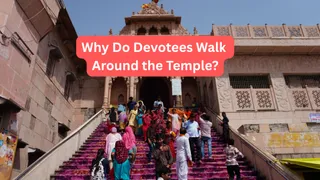
You must have noticed that whenever a devotee visits a temple, after worshipping, they often circle it. Some people also circle a sacred peepal tree or a tulsi plant. This act of circling a temple, deity, or sacred object is called Parikrama or Pradakshina, a practice being observed in Hindu traditions for centuries.
According to Hindu beliefs, Parikrama holds immense spiritual importance as it reflects the deeper truths about humility, awareness, and the relationship between the individual and the divine.
Let's understand in detail why devotees perform Parikrama.
What Is Parikrama And Its Significance
Parikrama (circumambulation), also known as Pradakshina, is a ritual in which a person walks around a sacred deity or object. In Sanskrit, ‘Pari’ means ‘around,’ and ‘Krama’ means ‘to go’. Therefore, the word Parikrama means ‘going around’.
Parikrama is performed after offering prayers to the deities and is done in a calm, meditative state. Hindus often perform parikrama after worshipping. Devotees walk around the deity with folded hands, keeping the deity at the centre.
According to Hindu beliefs, doing a Parikrama symbolises moving through the cycle of life, death, and re-birth. By keeping the deity at the centre while walking around, devotees acknowledge the spiritual truth that life keeps moving, circumstances change constantly, and the world remains in constant motion, yet the divine remains constant. It is also believed that doing parikrama around the deity reduces karmic burdens and washes away sins.
Similarly, performing Parikrama around the sacred Peepal tree, Tulsi (Indian basil plant), and Agni (sacred fire or the fire God) reflects the belief that every sacred object in the universe contains divine energy. Although this energy is mainly concentrated in that object, it extends to a certain distance. Therefore, by walking around these sacred objects, devotees come into contact with the aura of that sacred energy, which is very helpful, both spiritually and physically.
Parikrama symbolises moving through the cycle of life, death, and re-birth (Image: Instagram/astrohelp121)
ALSO READ: Why Is Touching Books And People With Feet Considered Inauspicious?
What Does Each Round Of Parikrama Mean?
The number of parikramas taken by devotees depends on the deity being worshipped, like one for Lord Ganesha, two for Lord Surya, three for Lord Shiva, four for Lord Vishnu and so on. Generally, a devotee only has to take one around the deity and sometimes even 100.
According to the Skanda Purana, the first Parikrama is believed to destroy sins committed through the mind; the second removes sins committed through speech, while the third is believed to destroy sins committed by the body.
Why Is Parikrama Done Clockwise?
Devotees always perform Parikrama in the clockwise direction, keeping the deity or object on their right side. This symbolises honour, auspiciousness, and walking on the path of righteousness.
Moving around the deity while keeping it in the centre is believed to align a person with natural cosmic energies rather than resisting it. It gently trains the mind to flow with life instead of moving against it. This movement reinforces the idea that spiritual growth does not come through force, but through alignment and awareness.
It also reminds devotees that all actions and thoughts should remain centred on God, the universal power that sustains life.
Moving around the deity while keeping it in the centre is believed to align a person with natural cosmic energies (Image: Pexels)
ALSO READ: Why Do We Remove Footwear Before Entering A Temple? The Spiritual Meaning Explained
Thus, devotees performing Parikrama or Pradakshina cultivate awareness, humility, and inner alignment. It is advised that devotees performing the parikrama should walk slowly, as it helps calm the mind, reduce ego and bring inner peace.