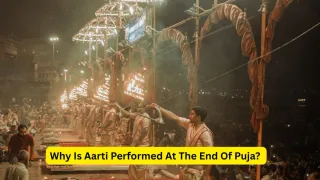
Have you ever wondered why in Hinduism aarti is performed at the end of the puja rituals?
According to scriptures, aarti done by devotees symbolically represents devotion, gratitude, and complete surrender to the divine. The origin of aarti dates back to early Vedic fire rituals, where darkness was dispelled by lighting a lamp.
Let's understand in detail what aarti actually represents and why it is done.
What Is Aarti?
The word aarti is derived from the Sanskrit ‘aaratrika’, which means removing the darkness of the night.
The word is also spelled as Arti, or Arati. It is a Hindu ritual in which light from wicks soaked in ghee (purified butter) or camphor is offered to one or more deities.
According to Hindu scriptures, the Skanda Purana, Agni Purana and Bhagavata Purana, performing aarti in front of the divine is an act of devotion that brings the devotee closer to God and creates a peaceful atmosphere. It is also one of the sixteen steps of the pooja ritual called Shodashaupachara.
Performing aarti in front of the divine is an act of devotion that brings the devotee closer to God (Image: Pexels)
Why Is Aarti Performed At The End Of Puja?
In most Hindu worship, the aarti is performed at the end of the puja because it represents the completion of the puja. It helps devotees:
- To conclude the puja with gratitude.
- Absorb the positive spiritual energy generated during the puja.
- Remind devotees of selfless love towards God
- Stay vigilant so that worldly thoughts, achievements, and desires cannot overcome the mind.
What Does Aarti Represent?
1. Five Elements (Panchabhuta): Aarti is said to represent the five elements of nature. These five elements are collectively called pancha bhootam and are symbolised as space, earth, fire, water and air. By doing aarti, devotees symbolically honour the divine and are offering cosmic energy (prana) back to its creator.
2. Purifies The 5 Senses: Aarti traditionally includes offerings that engage all five senses, which helps the mind and senses remain focused on God throughout the worship.
3. Complete Surrender To God By Burning The Ego: Aarti is performed using Camphor or ‘kapoor’. When camphor burns, it leaves no trace, which signifies an individual's inherent tendencies (Vaasanas) or ego. When the fire of knowledge lights and illumines truth, ego is destroyed and one completely surrenders to God, symbolically representing the state when our eyes are closed.
4. Victory of Light Over Darkness: The flame of the diya represents wisdom, knowledge, and divine light. While performing Aarti, devotees pray to remove the darkness of ignorance and fill their hearts with spiritual knowledge.
ALSO READ: Lighting A Diya Before Puja: Know Why This Ritual Holds Deep Spiritual Significance
The Correct Way To Perform The Aarti
Hold the lamp in the right hand and move it in a clockwise direction, forming gentle circles. Traditionally, the flame is waved seven times before the deity, first at the feet (four times), then the navel (two times), then once around the entire form. It is advised to always perform the aarti slowly and gracefully, never hurried.
Common Mistake To Avoid During Aarti
The Aarti should never be circled over the head of the deity because the rajasic frequencies produced during the Aarti are believed to interfere with the sattva particles released from the head of the deity. This creates friction in the sattva particles before they are transmitted.
When the plate is waved at exactly the head level, the frequencies complement each other, and the sattva particles get transmitted effectively.
The Aarti should never be circled over the head of the deity (Image: Pexels)
How To Do Aarti: Step-by-Step Guide
- Prepare the aarti thali by placing a diya or camphor lamp, flowers, akshat and a small bell on a clean thali
- Light the lamp with a ghee diya or camphor and ring the bell to begin
- Begin the circles by holding the lamp in the right hand and waving it clockwise before the deity
- Perform the aarti by waving it from the feet, navel, face and whole form of the deity.
- Sing the aarti hymn while everyone joins in and claps
- After ending the aarti, offer the flame to family.
ALSO READ: 50+ Baby Girl Names Inspired By Radha With Their Meanings And Spiritual Significance
Now you know how to do the aarti and what it symbolically represents.
FAQs
1. In which direction should aarti be performed?
Aarti should be performed in a clockwise direction before the deity, holding the lamp in the right hand and moving it gently in circles.
2. Why do we take the aarti flame near our eyes and head?
Cupping the hands over the aarti flame and touching the eyes and head symbolises receiving the deity's light, warmth and blessings into oneself.