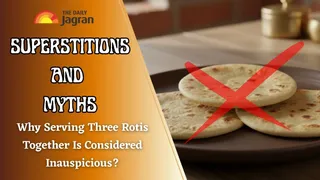
Have you ever noticed that your mother or any elder member of your family never keeps three rotis at one time on a plate? Sometimes, the third roti is cut into two pieces. Is it just an old superstition, or is there any reason behind it? In India, and especially in Hinduism, serving three rotis is believed to be highly inauspicious.
In The Daily Jagran’s Series Superstitions Myths, where we uncover the meaning behind popular Indian superstitions, let us try to find out the spiritual and general reasons behind why serving three rotis is inauspicious in Hinduism.
Why Serving Three Rotis Together Is Considered Inauspicious?
According to Indian tradition, having three rotis on a plate is extremely inauspicious. The reason for this is that the number three is linked to the food that is offered to the dead. In ancient times, three rotis were offered as an offering to the ancestors or the dead, and thus offering this to a living person is considered to be inauspicious. To keep everything in harmony, people usually break the third roti into two pieces before serving it.
The Concept Of “Teen Tigada Kaam Bigada”
There is a popular saying in Hindi, "Teen Tigada, Kaam Bigada," which means anything in three spoils the work. It is an indication that the number three is associated with difficulties and turbulence. As per numerology, even the act of serving three rotis can lead to more tension and arguments within the family. This is why people prefer to serve either less than three or more than three rotis.
Why Serving Three Rotis Is Considered Inauspicious In Hinduism. (Image Source: The Daily Jagran)
Practical Health Reasons For Not Serving Three Rotis Together
From a health perspective, two rotis are sufficient for a normal meal. The third one is considered too much or a sign of greed. To get rid of this superstition, people used to serve the first two rotis together and then serve the third one separately or break the third one into two pieces.
ALSO READ: Does A Cawing Crow Really Mean Arrival Of A Guest? Let Us Uncover This Indian Superstition
The custom of not serving three rotis on a plate comes from old beliefs, numerology, and health reasons. No matter why you follow it, this tradition respects the knowledge and culture of past generations. Think about these reasons next time you serve rotis!
For more such stories, stay tuned to The Daily Jagran!
(Disclaimer: This content includes advice providing generic information only. It is in no way a substitute for qualified spiritual or astrological opinion. Always consult a specialist for more information before adopting any measures.)