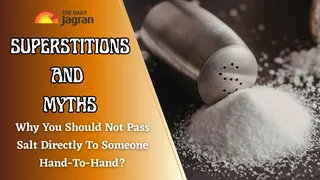
Have you ever noticed that the elders at home do not offer you the packet of salt directly? Instead, they say, “Put the salt down first, I’ll pick it up.” In India, there is a superstition that passing salt from hand to hand may turn a friendship bitter, leading to arguments. What is the actual logic behind this peculiar practice? Let’s dig a little deeper into this today, in The Daily Jagran’s series Superstitions Myths.
Why You Should Not Pass Salt Directly To Someone Hand-To-Hand?
Fear Of Souring Relationships
Salt is not directly passed from hand to hand because it is said that it might create a bitter relationship between the giver and the receiver of the salt. It is assumed that salt represents the concept of bitterness, and hence, it might give rise to unnecessary problems and conflicts between the parties involved. Therefore, instead of giving the salt hand-to-hand, it is left on the table for the other person to pick up.
Influence Of Shani And Rahu
According to astrology, salt is associated with the planet Saturn and Rahu. It is believed that if salt is passed from one hand to another, it can transfer a person’s negative energies and cause strife at home or with good fortune. In order to preserve positive energies, salt is never passe from one hand to another.
ALSO READ: Why 3 And 13 Are Considered Unlucky Numbers? Know Reason Behind This Bizzare Superstition
Why you should not pass salt directly to a person's hand. (Image Source: The Daily Jagran)
The Relationship Of Salt With Loyalty In Indian Culture
Throughout the ages, salt has been a valued commodity, a symbol of loyalty. The idea of paying one’s due to salt is embedded in our culture. People believed that salt should not be let fall from the hands, or it would bring bad luck. As the chance of spilling salt when it is being handed out is high, the habit of keeping it safe has been formed.
Scientific Reason And Cleanliness
If you think practically, it is possible that hygiene may be the answer associated with the logic behind not passing salt with hands. Our hands are untidy after meals, and touching salt or the salt packet may transfer germs. In the old days, people avoided touching these things directly to avoid illness, but this gradually turned into a superstition.
ALSO READ: Why Serving Three Rotis Together Is Considered Inauspicious? Let Us Uncover This Indian Superstition
Conclusion
While this may just be an old superstition or perhaps something more profound, the point is that many Indian families continue to follow this principle with love and devotion. After all, it is all in the name of preserving relationships and maintaining harmony. So the next time someone asks for salt, don't just give it to them, smile and keep it nearby!
(Disclaimer: This content includes advice providing generic information only. It is in no way a substitute for qualified spiritual or astrological opinion. Always consult a specialist for more information before adopting any measures.)