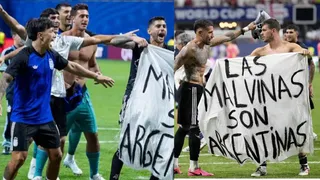
Argentina's dramatic 2-1 comeback victory over England in the FIFA World Cup 2026 semi-final was overshadowed by an emotional post-match celebration that could now land the reigning champions in trouble with FIFA.
After sealing their place in a second consecutive World Cup final in Atlanta, midfielder Giovani Lo Celso and defender Nicolas Otamendi were seen holding a banner that read "Las Malvinas son Argentinas" ("The Malvinas are Argentine"). The message refers to Argentina's long-standing claim over the Falkland Islands, a disputed British Overseas Territory known as the Islas Malvinas in Argentina.
While the moment was celebrated by many Argentine supporters, it has also sparked debate over whether the players breached FIFA's rules on political messaging.
ALSO READ: What Went Wrong for England? Tuchel's Ultra-Defensive Tactics Backfired Against Argentina
What is the Falkland Islands issue?
The Falkland Islands comprise a remote archipelago that is situated in the South Atlantic, approximately 500 kilometers from the coast of Argentina. Although the islands have been under British rule since 1833, Argentina has persistently asserted its right over the islands by calling them Islas Malvinas.
The conflict dates back nearly two centuries, yet it became particularly heated in 1982 when Argentina invaded the islands. In response to the invasion, Britain decided to send a military force to the island, triggering the Falklands War, which lasted for 74 days. The war ended with the islands falling back into British hands.
In total, the war claimed the lives of around 650 Argentinean people and about 255 British soldiers, making this one of the most serious issues in modern Argentine history.
Despite numerous talks at the UN, both sides maintain their positions. While Britain insists that the islanders are entitled to determine their fate, Argentina believes that the territory is a part of its sovereignty.
Due to its importance in history and politics, “Las Malvinas son Argentinas” has gained popularity as a national slogan in Argentina and appears on numerous patriotic occasions.
Why could Argentina face FIFA sanctions?
Although the banner reflected Argentina's political stance rather than an on-field incident, FIFA regulations are clear about keeping political messages away from football competitions.
The International Football Association Board (IFAB) and FIFA prohibit players from displaying political, religious, or personal slogans, statements, or symbols during official matches and post-match celebrations.
Law 4 of the IFAB Laws of the Game states:
"Equipment must not have any political, religious or personal slogans, statements or images... For any offence, the player and/or the team will be sanctioned by the competition organiser, the national football association or by FIFA."
Since the banner was displayed immediately after an official FIFA World Cup match, the governing body could review the incident under its disciplinary regulations.
What punishment could FIFA impose?
FIFA has not made any announcement regarding the procedure regarding the Argentine side and the participants in the incident.
However, mostly in previous scenarios where there were political expressions, implementation of a fine, warning or punishment has been observed against the players and national Federations in general. What kind of punishment would be imposed depends on FIFA's assessment of the case in terms of the severity of the player's action.
With Argentina going to the FIFA World Cup Final to compete against Spain, FIFA is expected to investigate the matter thoroughly before making any decision about disciplinary measures.