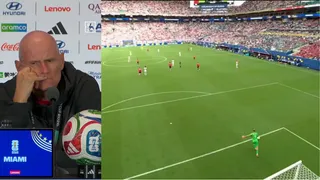
The FIFA World Cup 2026 has witnessed its fair share of controversies, and another incident was added to the growing list during England's dramatic quarter-final victory over Norway.
Moments before England's equaliser, Norway head coach Stale Solbakken claimed the ball had struck the overhead camera cable, insisting it changed the trajectory before the goal was scored.
Despite the protests, England completed a sensational 2-1 comeback to book their place in the FIFA World Cup 2026 semi-finals. The incident has since gone viral on social media, with fans debating whether the goal should have stood.
What Actually Happened?
The controversy unfolded in first-half stoppage time when England found the equaliser. Norway players immediately appealed, believing the ball had made contact with the overhead camera cable before dropping into play.
Under the Laws of the Game, if the ball touches an outside agent such as an overhead cable that interferes with play, the referee is expected to stop the match and restart with a dropped ball. However, referee Clement Turpin allowed play to continue as neither he nor his officiating team detected any contact.
After the match, Solbakken admitted there was little that could be done despite believing the incident had gone against his side.
"That was unlucky for us," Solbakken said. "The ball fell straight down from the sky, so it changed its direction. But we can't do anything about that. I don't think we will play the game again. So, that's how it is."
The Norway boss also defended referee Turpin, saying the French official could only make a decision based on what he had seen on the pitch.
"He says that he didn't see it himself, and that he didn't get any message that it actually happened, and that's a good explanation," Solbakken added.
FIFA's Statement On The Incident
Following the growing debate, FIFA released an official statement explaining why the goal was allowed to stand.
According to football's governing body, data from the Connected Ball technology showed no indication that the ball had made contact with the overhead cable.
"Before England's goal in minute 45+2 against Norway, the sensor in the Connected Ball showed no peak in the 'heartbeat of the ball' when in the air, and therefore no evidence that the ball touched the overhead wire and changed the movement of the ball," FIFA said in its statement.
The Connected Ball technology, which contains an internal motion sensor, is capable of detecting even the slightest touch. FIFA maintained that the data provided no evidence to overturn the on-field decision.
WATCH: Viral England Goal Sparks Debate
Videos of the incident have quickly spread across social media, with several angles appearing to show the ball passing extremely close to the overhead cable.
However, FIFA's sensor data and the match officials' assessment ultimately settled the matter, allowing England's equaliser to stand before Jude Bellingham's second-half winner completed the comeback.
What's Next For Norway?
Norway's impressive FIFA World Cup 2026 campaign comes to an end in heartbreaking fashion after pushing one of the tournament favourites to the limit. Solbakken's side earned plenty of praise with their fearless performances throughout the competition but now bow out at the quarter-final stage.
England, meanwhile, march into the semi-finals with momentum on their side and will now turn their focus towards another massive knockout clash as they continue their quest for a second FIFA World Cup title.