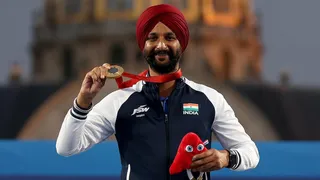
The Indian contingent went to the Paris Paralympics with high hopes and great intent, especially in para-archery.
Although Sheetal Devi, who is the country's first armless archer, along with Rakesh Kumar proved everyone right by winning the bronze medal in the mixed team compound open event earlier this month, nobody expected that Harvinder Singh would clinch the gold medal in the men's individual recurve open category at the Esplanade des Invalides just after a few days.
The 33-year-old Singh, who had won the country's first-ever Paralympic medal in the sport, a bronze in Tokyo, scripted history in Paris by winning the gold medal quite comprehensively, a 6-0 win against Poland's Lukasz Ciszek in the summit clash.
Belonging to a middle-class family in a remote village in Haryana, Harvinder suffered from dengue when he was just one-and-a-half years old and was given an injection by a local doctor, which had its side effects as his left leg stopped properly.
In an exclusive interaction with Jagran English, Harvinder talked about his successful stint in Paris and how he prepared for such a brilliant performance.
Excerpts from the interview:
Q: What was the first conversation you had with your family members after scripting history by winning the gold medal?
Harvinder: I wanted to speak to my family after reaching the final since the medal had been assured and they must have been so happy but I also had to make sure that my focus remained on the summit clash. Moments after winning the final and completing a few formalities, I spoke with my family through another phone since I didn't want to switch on my device. I had the mixed team matches the next day.
I had a video call with my wife, Manpreet, and father, Paramjit. My father got emotional and told me, "I am proud of you beta!".
Q: You got married after the Tokyo Paralympics and then had been blessed with a son. How has that changed your life as an athlete?
Harvinder: I got engaged before Tokyo. Now the destinies of my wife and child are also attached to me. Their prayers are with me. Also, you are mentally at peace as along with a caretaker, my wife is there to look after my father, who has endured a few health issues. My son keeps him busy. Another thing is that there are more people to celebrate with you in your happy moments.
Q: Talking about your performance at the Paralympics- in Tokyo, you had very close matches- three went to shoot-offs. In Paris, there was not even one. Was there a conscious effort this time to avoid shoot-offs?
Harvinder: Shoot-offs bring a lot of pressure. My aim was to not let things go down the wire and try to finish the match as soon as possible. I managed to achieve this in the final which I won 6-0. A matter of a few millimeters can decide the winner in the shoot-off and obviously, there is a lot of pressure. Even though I had experience handling shoot-offs, it was better not to get into those situations. This was my thought process. This is how I practiced and I applied that in the tournament.
Q: Did you follow the archery team's performance at the Olympics? Did close defeats and heartbreaks from those matches and the fact that Rakesh Kumar finished fourth in the men's compound open in the Paralympics play a role in this mentality of yours to avoid tense finishes?
Harvinder: I did follow the Olympics and what I learned from the matches I watched was to finish the set with a 10. It does not matter if you have two 10s or a 10 and an 8. The third arrow is the decider. It would either be a 10 to win or a 10 to tie. I focussed on finishing the set with a 10 during my practice sessions and I did find success in this during the quarterfinals, semifinals, and the final.
Q: After Tokyo, you won the bronze medal in the men's doubles at the Guangzhou Asian Games, but as far as an individual category is concerned, there was a little bit of inconsistency. During the ranking round in Paris, you finished ninth and later revealed in an interview that you felt a bit underconfident as you expected better from yourself. Did that help as there was a gap between the ranking round (29th August) and the elimination stage (4th September)?
Harvinder: We had been training in Champagne, which is about 100km away from Paris for 15 days. I was shooting better than my world records during the [racticse sessions under good weather conditions. However, when we arrived in Paris, my scores were a hit. In the ranking round, I shot 637, when I expected something above 650. I was disappointed but my experience told me that in the larger context ranking did not matter. In Tokyo, I finished 21st in the ranking round and won the bronze. The five-day gap helped. The daily practice sessions of two to two-and-a-half hours allowed me to play my strategy for the elimination stage.
Q: Do you believe in luck? In your first match against Chianese Taipei's Tseng Luing-Hui, you started well but there was a point when he needed an 8 to win the fourth set, but instead, he hit a 6. When your opponent makes such a mistake, do you ever feel like, 'Today is my day and I can't let this chance go'?
Harvinder: I don't believe in luck. Hard work and luck both go together.
Archery is an unpredictable sport. For instance, in my matches, I needed a 10 to win and I got it. In the semifinal, I needed an 8 to seal the victory and I got an 8. The players feel a lot of pressure and it also leads to completely missing the target once. I have also seen instances, where someone needs a 9 to win and they end up with an 8, handing over the victory to the opponent. It is due to the pressure of the situation.
Q: After winning the gold medal in the individual event, you, along with Pooja Jatyan, had that unfortunate finish in the mixed team event on the next day. What was going through your mind?
Harvinder: I had a few interviews and formalities till late at night when I won gold in the individual event but I knew that I had another event on the next day. So I did not switch my mobile on to stay focussed. Our first two matches took place when it was raining. After losing the semifinal, we don't want to leave without a medal. Personally, it would have been a historic achievement to win two Paralympic medals in the same edition.
Q: Para archery is a different challenge since you have certain physical limitations. In your case, how do you manage your body balance and heart rate?
Harvinder: Physical strength is the key. Limitations are the reason for lower scores in para-archery. These limitations do not allow us to use heavy poundage. I have a problem with my body balance as my weight is more on the right leg.
As soon as I shoot an arrow, I go into the resting leg and my body weight is entirely on my right leg. When the arrow is in position, I put weight on both legs and shoot.