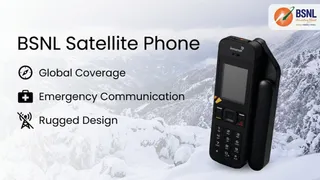
BSNL Satellite Phone: Losing mobile signal is frustrating, but for some people, it's part of the job. Whether it's a ship in the middle of the sea, a remote mining site or a mountain expedition, there are places where even the strongest mobile network simply disappears. That's the gap BSNL is now looking to fill with its latest launch.
The state-run telecom operator has introduced a satellite phone in India, a device that can make voice calls without depending on mobile towers. Instead, it communicates directly with satellites, allowing users to stay connected in areas where conventional telecom networks don't exist.
Image Credits: X/@BSNLCoporate
But hold on! This isn’t going to be an ideal back-up phone just yet. This is because it is not something that everyone has access to. In India, satellite phones have a number of regulations by the government, and you have to receive permission from the Department of Telecommunications (DoT) before buying or using the phone.
The BSNL satellite phone is priced at Rs 1,34,166, inclusive of taxes.
No Mobile Tower? That's Exactly What It's Built For
A regular smartphone is only as good as the network around it. Once you're outside the coverage of a mobile tower, making a call becomes impossible.
A satellite phone works differently. Instead of searching for a nearby tower, it connects directly to satellites orbiting the Earth. That means users can continue making voice calls from places where conventional mobile services are unavailable.
This makes the device particularly useful during emergencies as well. Natural disasters often damage telecom infrastructure, while remote regions may never have had reliable network coverage in the first place. In both situations, satellite communication can become the only dependable way to stay connected.
BSNL says the service has been developed in partnership with global satellite communication providers, including Inmarsat, to enable connectivity across remote regions.
Built for Reliability, Not Entertainment
Don't expect flagship smartphone features here. The satellite phone isn't designed for gaming, photography or binge watching videos.
Instead, the focus is entirely on dependable communication.
According to BSNL, the handset supports satellite based voice calling, offers SOS functionality for emergency situations, packs a long lasting battery for extended use away from charging points and comes with a rugged design that can withstand challenging environments.
Every feature has been added with one purpose in mind: helping users stay connected when conventional mobile networks cannot.
Who Is It Really For?
The average smartphone user is unlikely to need a satellite phone, and BSNL isn't marketing it as one.
Instead, the device is aimed at people whose work regularly takes them beyond the reach of mobile towers. That includes defence personnel, disaster response teams, maritime operators, mining companies and industrial workers in remote locations.
It could also prove useful for trekkers, mountaineers, expedition teams and pilgrims travelling through isolated regions where network coverage remains patchy or doesn't exist at all.
For these users, having a working phone isn't just about convenience. In many cases, it can be critical for safety.
You Can't Simply Buy One
The biggest hurdle isn't the price. It's the approval process.
Satellite phones are highly controlled in India, which implies that anyone wishing to buy and use a satellite phone must first get approval from the Department of Telecommunications.
Failing to seek approval before using the satellite phone will land you in trouble according to the law of India. Even if you are ready to pay more than Rs 1.34 lakh, you will require proper approval before using the satellite phone.
Those interested in the service can contact BSNL or visit the nearest BSNL office for more information.
A Different Direction for BSNL
This new satellite phone project comes at a time when BSNL is also developing its regular cellular phone network in India.
The telecommunication company has revealed that it has launched almost 99,000 4G sites through its expansion plans, and the government is also considering giving permission to the company to launch more 4G sites.
While those efforts are aimed at improving everyday mobile connectivity, the satellite phone addresses a completely different challenge. It's designed for places where setting up mobile towers isn't practical or where conventional networks simply can't reach.
For most people, this won't replace the smartphone in their pocket. But for those working in some of the country's toughest and most isolated environments, it could prove to be an essential communication tool rather than just another phone.