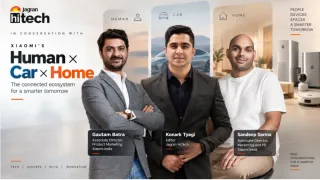
We were at IFA in Berlin last week, where we caught up with Sandeep Sarma, Associate Director, Marketing and PR, Xiaomi India and Gautam Batra, Associate Director, Product Marketing, Xiaomi India, to talk about Xiaomi’s big push towards consumer durables with the Mijia sub-brand.
Xiaomi has been increasingly talking about its “Human × Car × Home” ecosystem globally, and I saw a great display of it all coming together at IFA 26. What does this philosophy mean for Xiaomi’s India strategy, and which key product categories or SKUs do you see playing the biggest role here?
For us, Human × Car × Home is about creating one seamless connected experience across the different devices and environments that consumers interact with throughout the day. It is not a smartphone-led ecosystem alone. HyperOS is designed to be the foundation that connects these different experiences, with any device potentially becoming a point of interaction.
In India, the immediate opportunity is around strengthening the Home side of that ecosystem. Smartphones, TVs and tablets already give us a strong base, and we are now expanding further into smart home and large-appliance categories through Mijia. Over time, the ambition is to bring more categories into this connected experience, based on what makes sense for Indian consumers and the market.
There has been growing interest around the Mijia brand. What are Xiaomi’s plans for launching and expanding Mijia in India? Which product categories can Indian consumers expect, and is local manufacturing part of the strategy from the outset?
Mijia is going to play an increasingly important role in Xiaomi’s India ecosystem strategy. Historically, a number of smart-home products were brought to India under the Xiaomi brand. As the portfolio grows, we believe Mijia gives the home-appliance business a clearer identity and a dedicated focus.
We have already started this journey with categories such as air purifiers, and going forward, other smart-home and large-appliance categories are areas we are looking at closely.
On localisation, Xiaomi has been a strong believer in the Make in India journey. We were among the first to introduce a Made in India smartphone, and over the years we have progressively localised most of our product categories in the country. The intent is to extend that approach to the categories we enter in the future as well, including our home-appliance portfolio. The guiding principles will be the ability to localise, the scale and maturity of the category, and, most importantly, consumer demand.
With the festive season being a crucial period for consumer electronics, what is Xiaomi’s go-to-market strategy for Mijia in India? Will the brand adopt an online-first approach, or will Xiaomi also look at expanding through offline retail and new channel partnerships?
We do not see Mijia as an online-only proposition in the long term. Appliances are a very different category from smartphones, because consumers often want to see the product, understand how it works and experience it before making a purchase.
Digital channels will remain important for product discovery and commerce, particularly as we introduce newer categories. At the same time, as the portfolio and consumer awareness grow, offline retail and the right channel partnerships will become increasingly important.
The approach will depend on the category and how consumers prefer to shop for it. We have already seen this with our air-purifier portfolio, where we have expanded our presence to quick-commerce platforms alongside our existing online and offline channels. As we build Mijia further, we will continue to explore the right mix of channels and partnerships for each category.
Xiaomi’s EV ambitions have gained significant momentum in China with over 800k units sold. While you may not be able to share a specific timeline, when could India realistically expect to see a Xiaomi EV, even tentatively?
When we entered the EV business, the initial focus was very much on China. The first three years were about building the product, technology and manufacturing capabilities, while also understanding the market and scaling the business successfully in China. The next step is taking that experience beyond China. At IFA 2026, Xiaomi announced that its EV business will enter Europe in 2027, marking an important next phase in the internationalisation of the business.
India is a market that we know is very important, but an EV launch here would need to be evaluated separately, considering regulation, infrastructure, localisation requirements, customer expectations and the overall business case. So, while the China-first phase has now given us the opportunity to take the business into markets such as Europe, we cannot put even a tentative timeline on an India launch at this stage.
Xiaomi today operates across smartphones, consumer electronics, home appliances and now electric vehicles. Globally and increasingly in India, does Xiaomi see itself competing with companies such as Tesla and BYD on one hand, and LG, Samsung and Haier on the other? Or will smartphones continue to remain the company’s primary focus?
We increasingly think about Xiaomi not in terms of any one product category, but as a consumer technology company built around a connected ecosystem. Smartphones remain extremely important to us and will continue to be one of the core pillars of the business, but they are no longer the entirety of the Xiaomi story.
Globally, our portfolio now spans over 300 categories and more than 2,000 products, across smartphones, tablets, TVs, wearables, smart-home products, large appliances and EVs, with HyperOS and the broader IoT ecosystem helping connect these experiences. This naturally means that, at an individual product level, we compete with strong players across each of these categories.
However, we would not necessarily frame the strategy as simply choosing between competing with an automotive company on one side and an appliance company on the other. Our differentiation is the ability to bring these categories together through the Human × Car × Home ecosystem as the only brand in the world that can do this.
Individual products still need to compete strongly on their own merits, but the larger opportunity is the value consumers get when their smartphone, home appliances, smart devices and, eventually, their car can work together as one connected ecosystem.