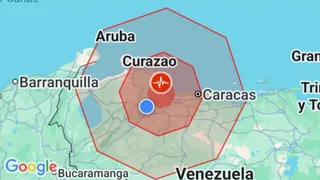
Google Earthquake Alert: Venezuela was rocked by two earthquakes back-to-back on Wednesday, which resulted in the collapse of many buildings in the vicinity of the earthquake-affected area and caused colossal damage in the region. The earthquakes that hit Venezuela were not light ones either and measured up to 7.2 and 7.5 in magnitude according to the seismographic readings. Amidst this, some users took to X (Twitter) and pointed out that Google already knew about the earthquake that was approaching just a few seconds before people actually felt its impact. But how?
ALSO READ: What Is LineShine? China's Supercomputer That Has Snatched The First Spot From US's El Capitan
One user on X posted a screenshot of a notification from Google that warned them of the said earthquake with a rough estimated magnitude of 6.2, which was calculated in real time and was not the final count, which it detected originating from 212.3 miles away, roughly 341 km. But how was Google able to detect this earthquake before it actually struck the area? The answer is sitting right inside your smartphone.
Image Credits: X/@HeverCastroB
Google Has A Massive Network
The smartphones that are sitting inside your pockets are no longer just simple devices that can only call and send text, and modern-day devices come equipped with what is known as an accelerometer. Usually what an accelerometer does is quite simple; it is what rotates the screen of your smartphone when you hold it in landscape to watch a movie or read a book, but it also comes with an ancillary function, and that is that it can detect and also measure vibrations.
Now when a vibration as strong as an earthquake hits your phone's accelerometer sensors, it sends a signal to Google's Android Earthquake Alerts System, and with it also goes rough information of where the impact might be. Now what Google does is that it brings together information from multiple devices in the vicinity to check if the earthquake is really happening or not. This step is taken after a single device sends the alert; the server then looks into other phones in the area for the same, and if enough devices showcase the same behaviour, Google knows that an earthquake is on the way, and then it starts sending alerts.
Google has a massive network of more than 2 billion users using Android phones that form a crucial part of this network, and this makes it one of the biggest seismographs (earthquake detectors) on the planet right now.
But How Does Your Phone Detect It Before The Earthquake Strikes?
Now all the tech is fine, but you may still be wondering how Google is able to do it even before the earthquake strikes. For this we need to understand how an earthquake actually takes place, and no, it's not just one single jolt that makes it happen; it happens in waves.
There are three types of waves that are involved in an earthquake: the P-waves (primary), S-waves (secondary) and Surface waves. P-waves travel at 5-15 km per second, which are the faster ones, and can go through solids, liquids and gases and cause minimal damage. Then come the S-waves, which travel at 2-4 km per second roughly, and these are the waves responsible for some damage caused, and a peculiar thing about these is that they move in a perpendicular direction to the wave, up-down or side-to-side, and can only travel through solids. Lastly, the waves that cause the most destruction arrive the last and are known as the surface waves, and these can travel on the surface only and are the slowest of all.
Now it's easy to break down that P-waves are the ones that reach your device first and are first to be recorded by seismographs and also the accelerometers on your smartphones, which detect them and send the signals to quickly notify the servers. Now this signal from your phone also travels at the speed of light, and this gives Google enough time to interpret the signal and also talk to other devices capturing the same signal and conclude if an earthquake is actually taking place.
Now the speed of light is faster than anything physically known in our universe; that means even earthquake waves, and if the epicentre of the earthquake is 341 km away, as was the case of Venezuela, Google's servers had enough time to interpret and send the signals back to all the devices in the vicinity.
Types of Alerts in Android for Earthquakes
When it comes to Androids' alert systems, it sends two types of alerts: the Be Aware Alert, which will give you a heads-up for light vibrations, and the other one is the Take Action Alert, which is when the shaking gets moderate to heavy, through which users can take action to protect themselves. Tapping on the alerts interface, the user can see safety information which includes necessary safety measures a user can take in case of an earthquake emergency. It also gives a detailed map which also gives out information about earthquakes, such as location and magnitude.
These Android alert systems are in place in India as well since 2023 and are supported by devices running on Android 5 and above, but there is one catch: you need a connection to Wi-Fi or cellular data to get these alerts, and these alerts can also be turned off from device settings.