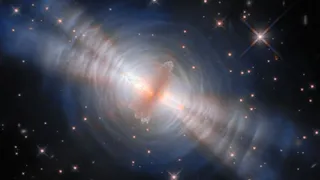
Some mesmerising images have just been captured from the Egg Nebula, orchestrating an interplay of light and shadows moulded by fresh stardust, snapshotted by NASA's Hubble Space Telescope. Located in the constellation Cygnus, which is 1000 light years away, the Egg Nebula consists of a star which is veiled by a thick cloud of dust, like a dark opaque egg yolk covering, like a bright core tucked within a dark outer layer.
ALSO READ: Jio’s Premium Plan With Unlimited 5G, Daily 3GB Data And OTT Perks: Check Price And Other Details
Light from the dying star doesn’t escape evenly. Instead, it shoots out through tiny gaps in the surrounding dust, bursting into bright beams that carve smoky lobes and ripple-like patterns into the cloud around it. This unusual view is helping scientists watch, almost in real time, how stars like our Sun peel away their outer layers before turning into planetary nebulae.
The object in focus is the Egg Nebula, known as the youngest and one of the closest preplanetary nebulae ever observed. NASA and ESA scientists say what we’re seeing isn’t glowing gas yet but starlight bouncing off thick dust that still hides the star at the centre.
Those striking twin beams are moving fast, pushing through older shells of material that were released earlier. Over time, those shells have been shaped into faint, curved arcs. The near-perfect symmetry of these patterns suggests the star may not be alone. An unseen companion, or even multiple companions, could be using gravity to shape how gas and dust are being thrown out.
This phase of the star’s life is incredibly brief. Scientists believe the dusty disc was expelled in just a few hundred years, an instant by cosmic standards. For now, the nebula reflects light rather than producing its own glow, which will only happen later when the core fully emerges and heats the surrounding gas.
ALSO READ: Microsoft Introduces ‘Secure By Default’ Feature For Windows 11, Here's What Its All About
Hubble’s long-term observations show that these controlled stellar outbursts don’t just signal the end of a star’s life. The dust and material they release eventually spread into space, helping seed future generations of stars and planetary systems.