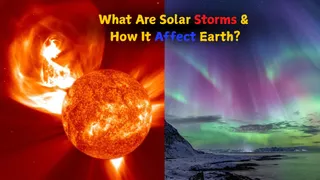
What are Solar Storms? Solar storms are extremely powerful energy discharges from the sun that go to the Earth through space. The sun looks tranquil from a distance, but it is actually very active, giving off light, heat, and charged particles. The sun constantly emits such particles. Now and then, solar activity gets so high that it causes the birth of solar storms. Solar storms are a normal part of the sun’s life cycle.
Generally, most solar storms just go by without making any trouble, but the very strong ones have the potential to affect things on Earth. Knowing what solar storms are and their influence on our planet helps us in being prepared and reducing risks. The rising reliance on technology makes it imperative to educate ourselves about solar storms.
What Are Solar Storms?
According to NASASolar storms are powerful disturbances that occur as a result of the rapid discharge of energy from the Sun’s surface. Their occurrence is mostly due to the explosive activity or the eruption of the Sun’s corona. These storms throw out a huge quantity of charged particles and radiation at very high velocities into outer space. When these particles are directed towards Earth, they interact with our planet's magnetic field.
Types of Solar Storms
There are basically three kinds of solar storms:
* Solar Flares: Sudden and huge energy release with enormous radiation emission.
* Coronal Mass Ejections (CME): Giant energetic particles thrown into space.
* Solar Wind Storms: High-velocity particle streams coming out of the Sun.
Each type affects Earth differently depending on its strength and direction.
How Do Solar Storms Reach Earth
Earth is surrounded by a magnetic field that is capable of repelling most solar particles. However, in the case of powerful solar storms, a few particles get through the magnetic field at the poles. Thereafter, the particles travel with the magnetic lines, and finally, they get in touch with the Earth's atmosphere. Solar storms are said to have a dual character, that is, they are beautiful and destructive both at the same time.
Effects of Solar Storms on Earth
Positive Effects
* Solar storms forms Magnificent auroras like the Northern and Southern Lights.
* It gives scientists the chance to investigate Earth's magnetic field, radiation and space weather.
* Solar storms can test the resilience of the electrical grid, resulting in better infrastructure and readiness.
Negative Effects
* Disrupt satellite communications and GPS services
* Triggers blackouts in radios, mainly in aeroplanes or ships
* Damage power grids, resulting in power blackouts
* Effecting Astronauts and High Altitude Flights related to Radiation
* Strong solar storms can slow down internet services, disturb mobile networks, and affect weather satellites.
*Modern technology is highly sensitive to space weather.
ALSO READ: NASA Astronaut Sunita Williams Retires After 27 Years: 10 Unknown Facts That Will Surprise You
Can Solar Storms Be Predicted? Why Solar Storms Matter
Space satellites are continuously monitoring the Sun. Although solar storms are unavoidable, early warnings can mitigate the loss to a great extent. Alerts allow the affected sectors, like businesses and governments, to protect their equipment and to prepare for emergencies.
As technology advances, susceptibility to space weather is going to be more and more hazardous. The deep study of the solar storm instigators will help to preserve future space exploration, energy generation, and even communication systems.