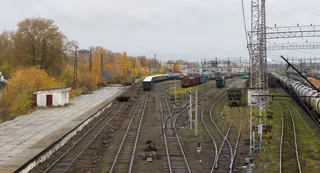
To facilitate trains running at speeds of 160 kmph on the country's busiest Delhi-Howrah rail corridor, the North Central Railway (NCR) has completed the installation of towers, Optical Fiber Cable (OFC), and Kavach equipment across 751 route kilometers from Chipyana Buzurg to Pt Deen Dayal Upadhyay (PDDU) station.
This installation covers both up and down lines. Additionally, Kavach will be implemented on the upcoming third and fourth lines, ensuring collision prevention. Once fully operational, 324 trains in the NCR zone will be able to operate smoothly at speeds between 130 and 160 kmph.
The Delhi-Howrah and Delhi-Mumbai railway lines, passing through NCR, are being upgraded with an investment of Rs 6,974.50 crore. As part of the Indian Railways' Mission Raftaar, the speed on the New Delhi-Howrah corridor is set to increase from 160 kmph to 200 kmph.
NCR will be the first among the 17 railway zones in India to be fully equipped with Kavach. This advanced safety system will be installed in over 700 trains operating on the 3,000-km NCR route. Currently, Kavach has been implemented in 200 locomotives.
Key Updates on Kavach Implementation in NCR:
-Successful trials conducted over an 80-km stretch between Palwal and Mathura.
-Loco trials are underway on a 167-km section from Ghaziabad to Kanpur.
-Loco trials are ongoing on a 185-km section from Kanpur to PDDU.
-Installation work is in progress on a 125-km stretch between Prayagraj and Kanpur.
-A Rs 350 crore tender was issued for Kavach installation across 415 km in the Mathura-Bina section.
Targeted Commissioning Timeline for Kavach on the Delhi-Howrah Route:
-Prayagraj-Kanpur – June 2025
-Tundla-Ghaziabad – June 2025
-Tundla-Kanpur – August 2025
-Prayagraj-PDDU – December 2025
-Mathura-Bina Section – December 2026
Kavach ensures train safety by using RFID tags and track-mounted sensors to measure the distance between trains. If the gap falls below the safety threshold, the system issues an alert. In case of an imminent collision, Kavach automatically applies brakes, even if the loco pilot fails to do so manually. This technology significantly enhances railway safety and efficiency.
With NCR achieving multiple milestones in its 22-year journey since its formation in April 2003, the implementation of Kavach marks a significant advancement in railway safety and speed optimisation.
READ MORE: Nagpur Woman Uncovers Husband's Dark Secret After Hacking WhatsApp, Gets Him Arrested