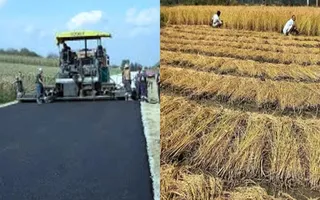
In a breakthrough linking agriculture, environment and infrastructure, the Dehradun-based CSIR–Indian Institute of Petroleum (CSIR-IIP) has developed an indigenous technology to produce bitumen for road construction using paddy stubble. The technology was formally transferred on Wednesday in the presence of Union Minister for Road Transport and Highways, Nitin Gadkari.
The innovation offers a single solution to two long-standing challenges: air pollution caused by stubble burning and India’s heavy dependence on imported bitumen. With this development, the stubble left behind after harvesting will no longer be a burden for farmers or a cause of smog, but will instead serve as a key raw material for building roads.
Under the new process, collected paddy stubble is converted into bio-oil through a special technique known as pyrolysis. This bio-oil is then processed to produce bio-bitumen. Scientific testing has shown that 20 to 30 per cent of conventional bitumen used in road construction can be replaced with bio-bitumen without compromising quality or durability.
CSIR Director General and Secretary, Department of Scientific and Industrial Research (DSIR), N Kalaiselvi, said India has become the first country in the world to scale bio-bitumen technology from laboratory research to industrial and commercial application within a year, calling it a significant achievement for Indian science.
Union Minister of State (Independent Charge) for Science and Technology and Earth Sciences, and Vice-President of CSIR, Dr Jitendra Singh, said the innovation would benefit farmers, protect the environment and strengthen the national economy. He noted that roads built using bio-bitumen would be cost-effective, more durable and help reduce pollution.
Dr Singh added that the technology has already been successfully tested on the Jorabat–Shillong Expressway (NH-40) in Meghalaya, where a 100-metre stretch of road was constructed using bio-bitumen. A patent has been filed for the innovation, and preparations are underway for its large-scale adoption in partnership with industry.
India currently imports nearly 50 per cent of its total bitumen requirement. Officials said nationwide adoption of bio-bitumen could result in annual foreign exchange savings of Rs 25,000 to Rs 30,000 crore, marking a major step towards cleaner, greener and self-reliant highways.