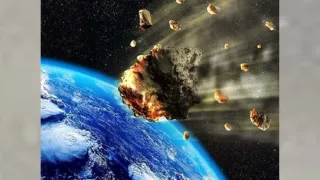
The asteroid 99942 Apophis, also known as the "God of Chaos," will pass extremely close to Earth on April 13, 2029. Discovered in 2004, Apophis initially raised concerns about a potential collision with Earth. However, precise calculations by scientists have confirmed that it will pass safely, at a distance of about 19,794 miles from Earth's surface.
With the concerns of a possible collision now ruled out, scientists have the opportunity to study Apophis, an asteroid dating back to the early days of the solar system. Discovered by astronomers Roy Tucker, David Tholen, and Fabrizio Bernardi, Apophis was initially flagged as one of the most dangerous near-Earth objects (NEOs).
It became a topic of public discussion after reports suggested it could potentially impact Earth in both 2029 and 2036.
Radar observations suggested Apophis will not have any impact on Earth for at least for next 100 years.
On April 13, 2029, Apophis will pass Earth at a distance closer than that of geosynchronous satellites, an exceptional event for an asteroid of its size. Viewers in the Eastern Hemisphere will even be able to see Apophis streak across the sky with the naked eye. NASA’s OSIRIS-APophis EXplorer (OSIRIS-APEX) spacecraft, previously focused on asteroid Bennu, will be retasked to conduct an in-depth study of Apophis during its approach, examining the asteroid’s surface composition, shape, and rotational speed.
Scientists are eager to study the shape, structure, and spin mechanics of Apophis. The close encounter may even trigger “asteroid quakes” due to the subtle but continuous gravitational influence from Earth on Apophis’s path and rotation. OSIRIS-APEX will closely analyze its surface and determine its chemical composition—information that is invaluable for understanding the history and formation of asteroids.