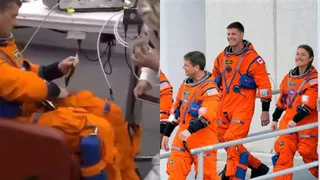
The Artemis II mission lifted off from NASA's Kennedy Space Center in Florida on Thursday, sending four astronauts around the Moon after 50 years. The crew aboard the Space Launch System, the most powerful rocket the agency has flown, embarked on a 10-day mission. The astronauts will test the Orion spacecraft's life support, navigation, and communication systems in space. They will also study radiation effects, conduct tests, and capture photos of the lunar surface while orbiting the Moon.
Astronauts To Use iPhones
Interestingly, the astronauts are carrying Apple iPhones on their 10-day mission around the Moon and back. The space agency’s team was seen placing the smartphones into the astronaut suits ahead of the launch. This comes after NASA administrator Jared Isaacman announced in February that astronauts are now cleared to take smartphones into space, starting with the SpaceX Crew-12 and Artemis II missions.
ALSO READ: How NASA Chooses 10 Candidates From Over 8,000 Applicants
Why Will They Use It On Airplane Mode?
As per NASA’s policy, astronauts have been allowed to take modern smartphones for personal use and to capture high-quality images during the lunar flyby. A strict protocol to prevent any interference to the existing systems will be placed while using the device. The iPhones will be kept onairplane mode, turning them into separate camera units. Through the inclusion of smartphones in their mission, NASA wants to make space exploration more relatable to the public with astronauts photographing the moment they feel more interesting and personal.
Earlier, in a post on X, Isaacman wrote, “NASA astronauts will soon fly with the latest smartphones, beginning with Crew-12 and Artemis II. We are giving our crews the tools to capture special moments for their families and share inspiring images and video with the world. Just as important, we challenged long-standing processes and qualified modern hardware for spaceflight on an expedited timeline. That operational urgency will serve NASA well as we pursue the highest-value science and research in orbit and on the lunar surface. This is a small step in the right direction.”
ALSO READ: How Astronauts Handle Periods In Space? NASA’s New Test Could Change Hygiene In Zero Gravity