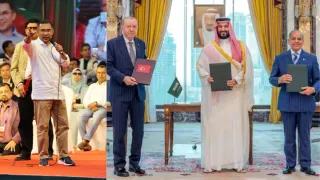
Dhaka/New Delhi: Bangladesh is open to joining the recently formed defence alliance between Saudi Arabia, Pakistan and Turkiye, two junior ministers have said, while stressing that any decision would be guided by the country's national interests. If Bangladesh joins the Pakistan-led Mecca Joint Defence Agreement, it would be concerning for India. However, the concern for New Delhi would be less about an immediate military threat and more about a gradual strategic shift in South Asia.
What is the Mecca pact?
Signed in Makkah on August 7, the pact establishes a framework for collective deterrence and stipulates that an armed attack on any one of the three countries would be considered an attack on all three.
"Bangladesh maintains a positive approach towards the possibility of joining an economic or defence framework involving Saudi Arabia, Pakistan and Turkiye, taking into account its own interests and the changing dynamics of the global economy and trade," newly appointed state minister for foreign affairs Humayun Kobir said.
Bangladesh has tweaked its foreign policy: Minister
In an interview with the Bangla service of state-run BSS on Friday, Kobir said the government was pursuing a "Bangladesh First" policy and a balanced foreign policy with national interests at its core, which might lead Dhaka to join the defence pact. He said Bangladesh would also strengthen bilateral ties with Pakistan through normal diplomatic engagement, focusing on trade and people-to-people connectivity.
Kobir, appointed as the second state minister for foreign affairs on Friday, said Prime Minister Tarique Rahman is expected to visit Riyadh at Saudi Crown Prince Mohammed bin Salman's invitation and the tour schedule is likely to be finalised after the summer.
Bangladesh First" policy marked a "paradigm shift"
Another state minister for foreign affairs, Shama Obaed Islam, in a separate media interaction on Friday, supplemented Kobir's comments, saying Bangladesh's national interest and the interests of its people would determine Dhaka's stance on joining the pact. "Whether we join any pact or any multilateral body will be decided primarily on whether Bangladesh's interests and the interests of the Bangladeshi people are protected," she said when asked whether Bangladesh would be part of the trilateral framework.
ALSO READ: The Mecca Pact And Its Implications For India | Opinion
The two junior ministers' comments came two days after Rahman's finance and planning adviser Professor Rashed Al Mahmud Titumir said a "Bangladesh First" policy marked a "paradigm shift" in the country's foreign policy. He said the policy placed national interest, sovereignty, mutual respect and regional harmony at the centre of Bangladesh's engagement with the international community by maintaining constructive and mutually beneficial relations with all countries.
"The Bangladesh First policy means putting Bangladesh's interests first, but Bangladesh for all," Titumir said.
Why Bangladesh joining could concern India
- Bangladesh would bring Pakistan into a security framework involving another country directly bordering India. That could give Islamabad greater diplomatic and strategic influence in South Asia.
- India already deals with Pakistan on its western flank. A Bangladesh-Pakistan security relationship could complicate India's eastern security calculations, especially if defence cooperation, intelligence sharing or military exercises expand.
- Pakistan could use the expanded pact to strengthen its claim as a leading security partner for Muslim-majority countries. Bangladesh joining would make that narrative more powerful.
But there is an important caveat.
Bangladesh joining would NOT automatically mean Bangladesh becomes part of an "anti-India NATO."
The existing Mecca pact does not currently have NATO's integrated command structure, standing forces or clearly defined military response mechanism. Analysts therefore describe it more as an emerging strategic framework than a fully operational military alliance.
(With inputs from agency)
You may also like to watch