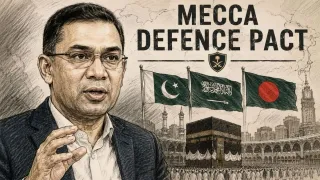
Dhaka/New Delhi: Amid concerns raised by India over its neighbour's intention to join a Pakistan-led defence pact, Bangladesh on Sunday downplayed the worries and asserted it saw "no risk" in joining the Mecca defence pact with Saudi Arabia, Turkiye and Islamabad. Dhaka said it would not restrict Dhaka's engagement with “other partners”. Although the minister who asserted did not name India in particular, it was obvious he was pointing fingers at New Delhi.
Signed on August 7, the ''Makkah Joint Defence Agreement'' establishes a framework for collective deterrence and stipulates that an armed attack on any one of the three countries would be considered an attack on all three.
"Internal matter of our Muslim family"
State Minister for Foreign Affairs Humaiun Kobir's statement during a media briefing came days after Foreign Minister Khalilur Rahman told Parliament that Bangladesh would positively consider joining the Mecca defence, if invited, and said it was an internal matter of "our Muslim family" with no scope for others to be concerned about it.
"This is a unique pact that presents new opportunities," Kobir told reporters at the Foreign Ministry after Saudi Ambassador to Bangladesh Abdullah Zafer bin Abiyah called on him.
"Will balance our international relations"
Kobir added Bangladesh was currently holding discussions on this matter and "those discussions are progressing positively with all bilateral partners." "A country like Bangladesh must approach foreign policy and security cooperation in a highly integrated and flexible manner, aligned with the dynamics of the current international political system," he said.
Kobir said, in line with this approach, "we will balance our international relations." "Entering into one specific sphere within today's volatile or crisis-driven international political climate does not mean you cannot contribute to other alliances or fields. It does not restrict your scope," the minister said.
He said he held a series of bilateral meetings, including with Saudi Foreign Minister Prince Faisal bin Farhan Al Saud during his Jeddah visit last week, and the pact was an issue of his discussions while his interlocutors' response was "positive, very positive."
No scope for others to be concerned: Rahman
Earlier on Thursday, replying when an independent lawmaker sought clarification on Dhaka's stance about joining the ''Mecca Pact'', Foreign Minister Rahman told Parliament, "We view this pact positively." The defence treaty is an "internal matter of our family, the Muslim family" and "there is no scope for others to be concerned about it," Rahman said.
Replying to a separate question by a ruling Bangladesh nationalist Party (BNP) lawmaker, he said Bangladesh now stood tall with dignity because of Prime Minister Tarique Rahman's strong and successful foreign policy. "Bangladesh will never bow its head to anyone again -- we have buried the subservient foreign policy," he said.
Minister Rahman, however, said Bangladesh is yet to receive any offer to join the pact, but if they express an intention to include Bangladesh, "we will certainly consider it positively."
What is Mecca Defence Pact?
On August 7, Pakistan, Saudi Arabia and Turkiye signed the ''Makkah Joint Defence Agreement'' amid increasing security concerns in the wake of escalating tensions in West Asia.
Pakistan Prime Minister Shehbaz Sharif, Saudi Crown Prince Mohammed bin Salman and Turkish President Recep Tayyip Erdogan signed the pact after the Makkah Al-Mukarramah Summit for Joint Defence at the Al-Safa Palace in Islam's holiest city of Mecca.
The ''Makkah Joint Defence Agreement'' is "intended to strengthen collective deterrence against any act of aggression, and stipulates that any armed attack against any one of the three States shall be regarded as an attack against them all," a joint statement said.
India's concerns
In New Delhi, replying to questions about the pact, India's External Affairs Ministry spokesman Randhir Jaiswal in his weekly briefing on Friday said, "We continue to closely follow all developments having a bearing on India's security and take all necessary steps to safeguard it."
(With inputs from agency)
You may also like to watch