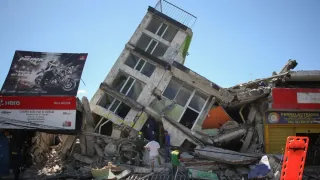
Colombia, a country positioned along the seismic "Ring of Fire," experiences thousands of minor earthquakes every month. However, this latest quake struck with unprecedented force, killing at least 132 people and injuring more than 570. As rescue operations continue, local authorities warn that the casualty count is expected to rise sharply.
Strongest earthquake in 100 years
Colombia’s Geological Service said Monday’s quake was the country’s strongest recorded “in the 21st century,” and that it was followed by several aftershocks. While Colombia typically registers thousands of small quakes every month, Northwestern University seismologist Suzan van der Lee said the strong magnitude, inland epicentre near soft river valleys and movement of the plates may have contributed to more intense damage.
(Credit: Reuters)
Colombia’s Pacific region around the epicentre lies along the “Ring of Fire,” the line of seismic faults encircling the Pacific Ocean where most of the world’s earthquakes occur.
Why is Colombia experiencing thousands of quakes every month?
Colombia sits directly along the Pacific "Ring of Fire," a high-seismicity zone where the Nazca tectonic plate is constantly sliding beneath the South American plate. Because of this subduction process, the country experiences thousands of minor, barely noticeable quakes every month. However, the recent 7.4 magnitude earthquake, Colombia’s strongest in a century, was a stark departure from these routine tremors.
Several geological factors converted standard tectonic activity into a historic disaster. First, the earthquake struck at a depth of 107 kilometres near Choco. While deep quakes often dissipate energy before reaching the surface, this shockwave was powerful enough to travel across vast distances, shaking major population centres like Cali and Risaralda.
Seismic energy accumulation
Second, seismic energy accumulates along major fault lines over decades. When a locked section of a fault line finally snaps after a long period of stress buildup, it releases an exponential amount of stored force compared to minor daily shifts.
This sudden, violent release sent powerful S-waves across western Colombia, causing widespread structural failure in unreinforced buildings. Combined with soft soil conditions in vulnerable urban areas, a routine subduction event turned into the region's deadliest seismic crisis in modern history.
(With inputs from agency)
You may also like to watch