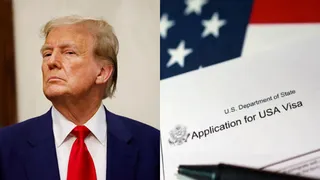
A US federal court on Tuesday struck down President Donald Trump’s decision to impose a USD 100,000 fee on new H-1B visas for highly skilled foreign workers. The ruling is being seen as a major setback for the administration's immigration policy. It is expected to bring relief to thousands of foreign professionals, including Indians who depend heavily on this visa programme to work in the US.
Court Rules Fee Was ‘Unlawful’
US District Judge Leo Sorokin in Boston ruled that the USD 100,000 fee was an “unlawful” tax because Congress had never authorised such a charge. The decision came in response to a lawsuit filed by 20 Democratic state attorneys general challenging the fee announced by Trump in September 2025.
“The President has no authority to levy a tax unless such a power is delegated by Congress through statute... the Court finds that the Policy imposes a tax on H-1B petitions without the requisite delegation by Congress. (hence) the Policy implementing the Proclamation is declared unlawful and is vacated in its entirety,” the court said.
Impact On H-1B Applications
The H-1B programme offers 65,000 visas annually, along with an additional 20,000 visas for workers holding advanced degrees. These visas are typically approved for three to six years. Before the policy changes, employers were paying between USD 2,000 and USD 5,000 to sponsor an H-1B worker. However, the increase in fee discouraged companies from applying for new visas.
According to court filings, as of February 15, the US Citizenship and Immigration Services (USCIS) had received only 85 payments under the new fee structure. The administration argued that the fee was not a tax but a monetary penalty that the President had the authority to impose under federal immigration law to restrict the entry of foreign nationals. However, the court rejected the argument, noting that only Congress can authorise such tax.
How Is It A Major Setback?
The ruling cripples the Trump administration's core immigration policy by blocking its main restrictive mechanism. Notably, the proclamation introducing the higher visa fee stated that the H-1B programme "has been deliberately exploited to replace, rather than supplement, American workers with lower-paid, lower-skilled labour," which has subsequently "undermined both our economic and national security."
It also claimed that some employers had abused the programme to suppress wages and make it harder to attract and retain highly skilled workers.
Will Indians Benefit?
The fee hike introduced by the Trump administration had raised concerns in India because Indian professionals account for a large share of H-1B visa holders. At the same time, thousands of technology-sector job cuts made it harder for foreign workers to find employment. As a result, visa applications from India declined, and many Indian workers who lost their jobs were forced to return home as they failed to secure a new employment, within the mandatory 60-day grace period.
In May, External Affairs Minister (EAM) S Jaishankar had also raised the issue with US Secretary of State Marco Rubio. Rubio acknowledged that there could be "some bumps" and "friction points" during the transition period as the US worked to improve its immigration system. He emphasised that the changes were not specifically targetted at India.
Since Indians receive most H-1B visas issued every year, the court’s decision is likely to provide significant relief to Indian professionals and IT companies.
You May Also Like To Watch: