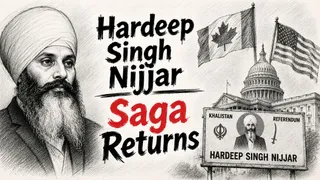
Hardeep Singh Nijjar, an Indian-origin Khalistani terrorist, was killed by "unknown assailants" in June 2023 outside a gurdwara in Canada. Months after his killing, then Canadian Prime Minister Justin Trudeau had a chaotic return to Ottawa after his decades-old aircraft encountered a technical malfunction following the G20 Summit. He had to remain in New Delhi for several days before he could return to Canada.
(Hardeep Singh Nijjar | Credit: Reuters)
Soon after returning to the Canadian Parliament, Trudeau levelled explosive allegations against Indian officials. He claimed that Indian government agents were involved in Nijjar's killing, triggering a major diplomatic crisis between India and Canada.
(Then Canada's Prime Minister Justin Trudeau rises to make a statement in the House of Commons on Parliament Hill in Ottawa, Ontario, Canada, Sept. 18, 2023. REUTERS)
New Delhi swiftly rejected the allegations. Later, the Royal Canadian Mounted Police (RCMP) also claimed to have evidence supporting the allegations. However, India maintained that Ottawa had never shared any credible proof to substantiate its claims. Subsequently, the RCMP acknowledged that there was no credible evidence directly linking the Indian government to Nijjar's killing. But the damage was already done.
Nijjar killing allegations have now reached US
Now, on Tuesday (local time), the US has charged Lawrence Bishnoi, a gangster imprisoned in India, and his aide Satinderjeet Singh alias Goldy Brar for ordering the killing of Nijjar. According to a federal indictment unsealed in Los Angeles on Tuesday, Bishnoi ordered the killing of Nijjar, mentioned as ''H.S.N.'' in court documents, outside a Sikh temple in Surrey, British Columbia, on June 18 three years ago.
In a coordinated action named ''Operation Hardball,'' the law enforcement agencies of the US, Canada and Europe arrested 24 persons – 11 of them in California – connected to three India-based transnational organised crime groups charged with a litany of criminal acts, including Nijjar's killing.
"Working together, law enforcement in the US, Canada, Europe, and Asia are determined to target and dismantle these criminal organisations wherever they operate. There is no safe harbour for these thugs," First Assistant United States Attorney Bill Essayli told a news conference in Los Angeles.
The current action is the result of a years-long federal investigation into Indian crime syndicates that engage in racketeering, targeted killings, shootings, extortion, the trafficking of bulk quantities of narcotics across international borders, and other crimes around the world whose impact is especially felt in the Indian diaspora.
Will fresh claims ruin India-US ties?
If the United States were to link the killing of Nijjar to the Lawrence Bishnoi gang rather than directly to the Indian government, the impact on India–US relations would likely be limited compared with the diplomatic crisis that unfolded between India and Canada. Such a finding would shift the focus from allegations of state involvement to transnational organised crime, reducing direct diplomatic pressure on New Delhi.
However, Washington would still be expected to seek India's cooperation in investigating the case and taking action against those responsible if any links to India emerged. Given the depth of India-US ties across defence, trade, technology, and the Indo-Pacific, both countries would likely seek to prevent the issue from overshadowing their broader strategic partnership. That said, the situation would become far more serious if credible evidence were to establish direct involvement by Indian state officials.
(With inputs from agency)
You may also like to watch