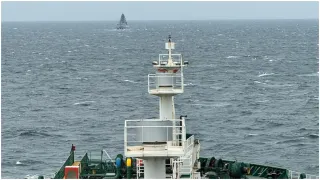
An Indian-flagged LPG tanker Pine Gas, originally scheduled to return within a week, remained stranded for over three weeks as tensions from the ongoing Iran-US war disrupted shipping movement through the Strait of Hormuz.
The Story Of Pine Gas LPG Carrier
Pine Gas, an Indian LPG carrier that recently passed through the Strait of Hormuz, had loaded its cargo at the UAE’s Ruwais port just a day before Israel and US carried out a sudden strike on Iran, an escalation that has shaken the Gulf region.
The journey was subsequently slowed as rising tensions between Iran and the US disrupted traffic in the crucial water passage, fuelling global concerns over oil and gas supplies. The delay also raised alarms in India amid rising concerns of LPG shortage.
Despite the hardships, the vessel, carrying 27 crew members, successfully completed its journey. Along with another Indian-flagged tanker, Jag Vasant, it brought LPG consignments to India. Jag Vasant docked at Kandla with 47,000 metric tonnes (MT) of LPG, while Pine Gas reached New Mangalore carrying around 45,000 metric tonnes of LPG.
Pine Gas Crew Saw 'Missiles And Drones Flying Overhead'
Pine Gas did make it to India, but the trip came with serious risks for both the vessel and those on board. Crew members reported seeing “missiles and drones flying overhead” almost daily.
As reported by Reuters, Chief Officer Sohan Lal said that the ship had originally been set to depart on March 11. However, due to the ongoing Iran-US war, the schedule was pushed back, and the vessel only received permission to sail on March 23.
Rather than using the standard shipping lanes through the Strait of Hormuz, the crew was directed by Iran’s Islamic Revolutionary Guard Corps (IRGC) to take a different route. This path required navigating a tight passage north of Larak Island, located off Iran’s coast.
Lal also shared that the responsibility for deciding whether to proceed rested with the crew themselves. Indian authorities and the vessel’s owner, Mumbai-based Seven Islands Shipping, asked for the crew’s call, stating “They needed a yes or a no from all crew.” In the end, everyone onboard agreed to move forward.
As per Reuters, Pine Gas was escorted by four Indian warships after which it moved out in the Arabian Sea from the Gulf of Oman. The warships tracked the route for 20 hours.
Amid the escalating conflict in the Middle East, Iran's Parliament Security Committee on Monday approved a new management plan for the Strait of Hormuz that includes measures to impose tolls on vessels passing through the strategic waterway and restrictions on certain countries, according to Iranian state media, Islamic Republic of Iran Broadcasting (IRIB).
What Is The New Management Plan For The Strait Of Hormuz?
According to Iranian state media, the plan introduces a rial-based toll system for vessels transitioning through the Strait of Hormuz, a vital shipping route between the Persian Gulf and the Gulf of Oman, that handles about one-fifth of the world's crude oil and liquefied natural gas (LNG) in peacetime.
The plan also outlines measures related to maritime security, vessel safety, environmental protection, and the financial mechanisms governing passage through the Strait.
The plan explicitly bans passage of US and Israeli vessels and extends restrictions to countries participating in unilateral sanctions against Iran, the report added.
Additionally, it reinforces Iran's sovereign control over the Strait of Hormuz and emphasises cooperation with Oman to establish a legal framework for its management.