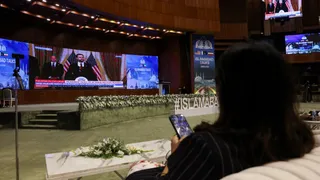
After the "failed" Islamabad Talks, fresh reports emerged claiming no phones were allowed inside the Serena Hotel, and the situation was largely hostile when the much-awaited peace talks were held between Iran and the US on Saturday. According to a report by the news agency Reuters, inside Islamabad's luxury Serena Hotel, the talks unfolded across two separate wings and one common area, one for the US side, one for the Iranians and one for trilateral meetings involving Pakistani mediators.
Phones were not allowed during Iran-US peace talks
Phones were not allowed in the main room, forcing delegates, including US Vice President JD Vance and Iranian Parliamentary Speaker Mohammad Baqer Qalibaf, to step out during breaks to relay messages back home, two of the sources said. The reports came amid Iranian claims that a call by Israeli Prime Minister Benjamin Netanyahu during the negotiations resulted in the collapse of peace talks, a claim later contested by the Israeli side.
(CREDIT: REUTERS)
ALSO READ: Islamabad Talks 2.0? Reports Hint US And Iran May Hold Second Round Of Peace Talks On THIS Date
Among the slew of issues at stake was the Strait of Hormuz, a major transit point for global energy supplies that Iran has effectively blocked, but the US has vowed to reopen, as well as Iran's nuclear programme and international sanctions on Tehran.
(CREDIT: REUTERS)
"There was a strong hope in the middle of the talks that there would be a breakthrough and the two sides would reach an agreement. However, things changed in no time," a Pakistani government source told Reuters.
Very close to agreement but...
Another source involved in the talks said the parties came "very close" to an agreement and were "80 per cent there" before running into decisions that could not be settled on the spot.
ALSO READ: Will US-Iran Have Another Round Of Peace Talks? JD Vance Says Tehran Needs To Make Next Move
Two senior Iranian sources described the atmosphere as heavy and unfriendly, adding that while Pakistan tried to soften the mood, neither side showed any willingness to ease tensions.
Nevertheless, the two Iranian sources said that by early Sunday morning, the atmosphere had shown some improvement, and the possibility of a one-day extension began to take shape.
However, differences persisted in the room. A US source told Reuters that Iranians did not properly understand that the core US aim was to have a deal that ensured Iran would never obtain a nuclear weapon. Among Iran's concerns was a distrust of US intentions.
(With inputs from Reuters)
You may also like to watch