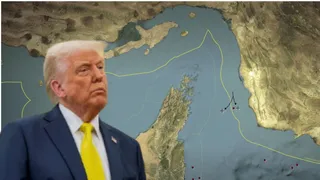
United States President Donald Trump is reportedly looking for a way out of the war, even if the Strait of Hormuz, the latest flashpoint after the alleged Iranian nuclear programme, remains closed.
According to a report by the Wall Street Journal, citing Trump administration officials, the US President has told his aides that he is willing to end the war and defer the Hormuz campaign to a later date.
Trump's remarks came as his administration has been deliberating for a few days on a ground offensive to seize Kharg and open the crucial chokepoint in the Persian Gulf.
Trump and his aides have assessed that any mission to open the strait would stretch the conflict beyond four to six weeks, a timeline the Trump administration had estimated before the war.
The WSJ report further suggests that the US has decided to limit its operations to achieve its main goals of hobbling Iran's navy and its missile stockpile and cease current hostilities thereafter.
Iran's grip on Strait of Hormuz tighter than ever
The latest development indicates that the ongoing war could end in a big setback for Trump and the US, as even eliminating Supreme Leader Ayatollah Ali Khamenei, apart from over two dozens of senior leaders and officials, and devastating the missile and naval capabilities, couldn't ensure Iran's total defeat; instead, it made its grip on Hormuz even firmer.
ALSO READ: Israeli PM Netanyahu Proposes Mediterranean Pipeline Rerouting To Bypass Strait Of Hormuz Amid War
According to a Bloomberg report, barely an average of six vessels pass through the Strait of Hormuz daily now, and that too belong either to Iran or countries described as friendly to Iran.
The report, citing figures, reported that 80 per cent of the oil tankers transiting the strait have been Iranian.
What shows increased control of Tehran is that the vessels, after talks with the Iranian authorities, are now sailing close to the Iranian side, avoiding the Omani side to reduce chances of a hit due to confusion.
War caused toll imposition on Hormuz transit
Besides, Iran has further strengthened its control of the strait as the parliament in Tehran approved a plan to levy tolls on vessels in transit. The plan also calls for banning the US and Israeli vessels from transiting the Hormuz.
The effective closure of Hormuz through threats and attacks has emerged as the most tested and high-yielding asymmetric weapon for Iran in this war.
The war was started on February 28 by the US and Israel, on the pretext of Tehran's nuclear programme, but Iran managed to amplify the economic and energy crunch of the regional war to the world by closing the Strait.
Iran could dominate Gulf if US pulls out
The US pullback would also leave lasting impact on the regional dynamics of the Middle East with Iran's proven dominance over Gulf countries, which it attacked fiercely in over a month.
The US' Gulf allies, including Saudi Arabia, Bahrain and the United Arab Emirates (UAE), have privately urged Trump to continue the war against Iran as it has not weakened enough.
Some of the Arabian allies have called the war a historic opportunity to cripple Tehran's clerical rule and hence the war should continue until a significant change in regime.