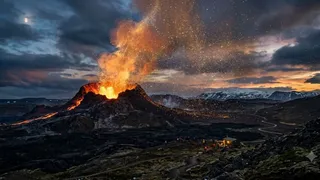
The southernmost active volcano on Earth, Mount Erebus, located in the deep-frozen landscape of Antarctica is famous for having a permanent lava lake. But it is also uniquely famous for releasing microscopic crystals of pure gold directly into the atmosphere. Scientists estimate that the volcano emits about 80 grams of gold every day, making it one of the most unusual natural wonders on the planet.
This extraordinary discovery was reported in a 1991 study published in Geophysical Research Letters. Researchers found that gases rising from the volcano carried tiny crystals of elemental gold. When scientists examined using powerful electron microscopes, they discovered that these were not ordinary dust particles. They were well-formed crystals of pure gold, with some measuring up to 60 micrometers in diameter.
Gold Worth Millions Every Year
According to scientists, Mount Erebus releases around 80 grams of gold every day. At current gold prices, that is worth about USD 6,000 (around Rs 5.66 lakh) daily. Over a year, the value of the gold released adds up to more than USD 2 million, or roughly Rs 18.9 crore. Interestingly, these gold crystals are carried high into the atmosphere by volcanic gases before settling on ice. They can travel as far as 1,000 kilometers from the volcano before falling back to the surface.
ALSO READ: Gold, Silver Rates Today: Bullion Price Fall Amid Subdued Demand, Check 24k, 22k Gold Rates
How Does The Volcano Release Gold?
Finding small amounts of gold in volcanic gases is not completely new. Scientists have detected traces of gold in emissions from volcanoes such as Kilauea in Hawaii, Mount Etna in Italy, Augustine Volcano in Alaska and El Chichon in Mexico. According to experts, gold is transported upward in extremely hot volcanic gases, where it attaches to compounds containing chlorine or sulphur. As the gases cool, the gold separates and forms tiny crystals.
Why Is This Volcano Different?
Many other volcanoes also release traces of gold, but Mount Erebus is the only one known to emit well-formed crystalline gold particles continuously. There are two widely circulated theories explaining the possible reasons. The first theory suggests that the gold crystals form directly from chlorine-rich volcanic gases as they cool after leaving the volcano.
Meanwhile, the second theory suggests that the gold crystals slowly develop on the surface of Mount Erebus' permanent lava lake. The crystals are then carried into the air by volcanic gases escaping from the lake.
You May Also Like To Watch: