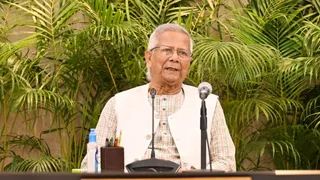
Bangladesh’s outgoing interim government chief Muhammad Yunus on Monday again spat venom by raking up his rhetoric of the ‘Seven Sisters’, a name widely used for India’s northeastern state. The "Seven Sisters" of India are seven contiguous northeastern states- Arunachal Pradesh, Assam, Manipur, Meghalaya, Mizoram, Nagaland, and Tripura.
Yunus' controversial farewell speech
Yunus, in his final televised speech to the nation before stepping down, dubbed Bangladesh's Bay of Bengal ports as a strategic asset. He advocated treating Bangladesh, Nepal, Bhutan, and India's 'Seven Sisters' region as an integrated economic zone, sparking debates over regional connectivity and sovereignty implications ahead of Tarique Rahman's government takeover.
"Our open seas are not just borders—they are gateways to the global economy. With Nepal, Bhutan, and the Seven Sisters, this region has immense economic potential. Economic zones, trade agreements, and duty-free market access can establish us as a global manufacturing hub," he said in Bangla.
ALSO READ: MEA Summons Bangladesh High Commissioner Over Dhaka Leader’s Threat To Cut Off India’s Seven Sisters
This is not the first time that Yunus raked up the north eastern states in his speech. Earlier last year, he sparked a similar controversy. This was also the reason why Dhaka's relations with New Delhi witnessed a significant downturn.
Yunus speech: An attempt to woo China
Yunus adopted a sharper tone in his farewell address, stressing "strategic balance" in foreign relations and underscoring deepened ties with China, Japan, the United States, and Europe. He pointed to advancements in Chinese-supported projects, notably significant progress on the Teesta River Comprehensive Management and Restoration Project-- located near India's strategically vital Siliguri Corridor, which New Delhi has long regarded with caution-- and the 1,000-bed Bangladesh-China Friendship Hospital in Nilphamari.
"We have also deepened cooperation with China. Significant progress has been made on the Teesta River project and a 1,000-bed international hospital in Nilphamari," Yunus stated. The remarks suggested Bangladesh's commitment to independent development priorities, potentially without prioritizing neighboring security sensitivities.
No mention of attacks on minorities
However, Yunus refrained from accepting the recent attacks on Hindus in Bangladesh. India has been expressing concerns over attacks on minorities, especially Hindus, in Bangladesh. The community has faced a series of attacks, some fatal, after the killing of radical youth leader Sharif Osman Hadi in December. Several foreign experts said Bangladesh earned little in foreign relations under Yunus' leadership, while ties with its immediate neighbour, India, saw their lowest ebb.
(With inputs from agency)