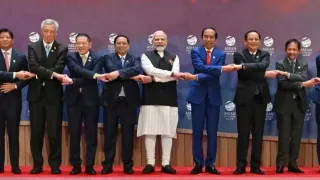
ASEAN Summit: Prime Minister Narendra Modi is all set to attend the 23rd ASEAN-India Summit and 21st East Asia Summit taking place in Manila, Philippines on November 16 and 17, 2026. The meetings will take place on the sidelines of the main 49th ASEAN Summit which the Philippines is hosting. Before leaving for Manila, PM Modi shared a message on X, saying he was looking forward to attending the two summits and meeting members of the Indian community in the Philippines. He also highlighted India's close friendship with ASEAN countries.
In a statement released by the PIB, PM Modi said that India's relationship with ASEAN is at the heart of its Act East Policy and has an important place in its MAHASAGAR vision. He added that the partnership has grown beyond historical and cultural ties to include trade, connectivity, maritime security, technology and people-to-people relations. But the question arises, why does India, which is not a member of ASEAN, take part in its summit meetings and why do they matter for New Delhi.
What Is ASEAN?
ASEAN stands for the Association of Southeast Asian Nations. It is a regional group formed to promote cooperation, peace, stability, and economic growth among countries in Southeast Asia. The organisation was established in 1967, and its first summit was held in Bali, Indonesia in February 1976. The ASEAN Summit is the group's highest decision-making meeting.
The summit, which is held biannually, brings together the heads of state or government of member countries to discuss important regional issues, set common priorities and strengthen cooperation. ASEAN currently has 11 member countries, including Brunei Darussalam, Cambodia, Indonesia, Laos, Malaysia, Myanmar, the Philippines, Singapore, Thailand, Timor-Leste and Vietnam.
Why India Is Not A Member Of ASEAN?
Indonesia is home to ASEAN's headquarters, which is in Jakarta. Despite being a significant country in Asia, India is not among these members. The main reason behind this is geography, as the ASEAN was formed as a group for countries in Southeast Asia, while India is located in South Asia. However, India has still built a strong partnership with the organisation over the years and takes part in several important regional meetings.
Another reason why India is not part of the group is that New Delhi followed a different economic and foreign policy approach when ASEAN was taking shape. During the Cold War, India was cautious about the group's political alignment over economy and market access, hence it stayed away. However, not being a member has not kept India away from ASEAN.
India became a sectoral dialogue partner in 1992, a full dialogue partner in 1996 and a summit-level partner in 2002. It now has a Comprehensive Strategic Partnership with ASEAN and regularly engages with the group through the ASEAN-India Summit.
Why ASEAN Matters To India?
For India, ASEAN is much more than a regional grouping. It is important for the country's economic growth, security, and position in the Indo-Pacific region. The bloc is also important to strengthen India's Act East Policy, launched in November 2014. The policy aims to build stronger economic, political, cultural and strategic ties with Southeast Asia, and the wider Indo-Pacific and ASEAN is at the centre of this policy.
The summit gives India an opportunity to discuss common priorities, improve cooperation and build stronger relations with its Southeast Asian neighbours such as Myanmar, Thailand, Indonesia.
Maintaining a balance in the Indo-Pacific: Another reason why ASEAN matters to India is to strengthen its strategic presence in the Indo-Pacific amid China’s growing influence. New Delhi supports an open, inclusive, and rules-based regional order through its engagement with ASEAN countries.
Maritime security: Maritime security is another front that matters to India, especially at a time when regional conflicts have disrupted the global supply chain. Southeast Asia is home to some of the world's busiest sea routes, including the Strait of Malacca. A large share of India's trade and energy supplies passes through these waters. This makes cooperation with ASEAN countries important for India.
Trade Ties: ASEAN is an important economic partner for India, with bilateral trade exceeding USD 122 billion. The summit, therefore, provides an opportunity to discuss ways to increase trade and improve market access
Regional connectivity: Regional connectivity is another important reason why ASEAN matters to India as better transport links can bring India and Southeast Asia closer. Projects such as the India-Myanmar-Thailand Trilateral Highway aim to connect India's Northeast with markets in Southeast Asia, making travel and trade easier.
Cultural ties: Apart from economic ties, India and Southeast Asian countries also share centuries-old cultural and civilizational links. Buddhism, historical trade routes and people-to-people connections have shaped these relations over the years. These shared links further provide India an opportunity to strengthen cultural exchanges, tourism, education and cooperation.
You May Also Like To Watch: