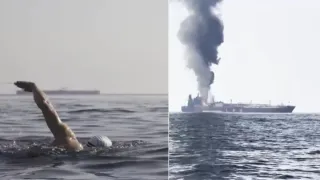
British endurance swimmer Lewis Pugh has completed a three-day swim through the Strait of Hormuz despite nearby attacks on oil tankers and commercial vessels. The 56-year-old undertook the challenge to draw attention to the environmental damage caused by the ongoing war with Iran, warning that oil spills and chemical pollution could threaten marine life for decades.
Lewis Pugh Takes On Dangerous Hormuz
Pugh, a United Nations Patron of the Oceans, covered around 15 kilometres in the waterway, swimming for a total of six and a half hours across three days. He began his journey from the Musandam peninsula, at the southern end of the strait, and finished near the Cape of Hormuz. During the swim, he wore only swimming trunks, goggles and a swimming cap with the UN logo. He is said to be the first person to complete a long-distance swim in the area since the war began.
Sharing his experience on X, Pugh said, "I have just completed a three-day swim through the Strait of Hormuz to draw attention to the devastating environmental consequences of war." He recalled that an oil tanker was hit just 30 minutes after he entered the water on Monday. The explosions were heard nearby and shook the surrounding sea. He also witnessed more attacks on commercial vessels on other days.
Pugh said, "War causes immense human suffering. Lives are lost, families are torn apart, and homes are destroyed. But there is another casualty that receives far too little attention: nature itself." He also noted the natural beauty of the Strait, describing its mountains, fjords, coral reefs and mangrove forests. Pugh added, "My message is simple: Stop the fighting. Open the Strait. Clean up the pollution."
Pugh Recalls Passing Attacked Gas Carrier
He also passed a gas carrier that had been attacked. Recalling the incident, he said, "I’ll never ever forget going past that gas carrier, the smell of the chemicals and then the flames, they were literally like fireballs going up into the sky. Around the ship, the water was on fire."
Pugh further warned that oil and chemical leaks from damaged vessels could seriously affect marine animals, coastlines, coral reefs and mangrove forests. He added that cleaning such pollution would be extremely difficult and its effects could continue for generations.
Hormuz Remains Key Flashpoint
The Strait of Hormuz is an important global shipping route, through which around one-fifth of the world's traded oil passed before the US and Israel launched the war on February 28. Iran has increased attacks on vessels it says used unauthorised routes, while several tankers have also hit sea mines. It has also emerged as a major point of contention in peace negotiations between Iran and the US.
You May Also Like To Watch: