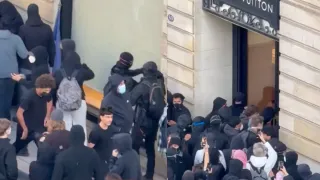
France Protest: Violent protests broke out across France on Saturday, October 17, as marches over the rising cost of living, education funding and crumbling public services turned into clashes with police, arson and widespread looting. Looters targeted public buildings and shops, including luxury stores such as Apple, Louis Vuitton and Hermès, in several cities. Reportedly, around 550,000 people took part in demonstrations nationwide, including an estimated 110,000 in Paris.
Authorities say more than 1,200 people were arrested and around 150 police officers were injured.
France’s Interior Minister Laurent Nunez put the nationwide turnout at around 550,000. According to Reuters, the CGT trade union estimated protesters closer to 800,000. Most people marched peacefully, but smaller groups smashed property, set cars on fire and fought with security forces.
Apple, Louis Vuitton and Hermès Stores Vandalised
In Bordeaux, looters smashed the windows of luxury shops including Apple, Louis Vuitton and Hermès. In Paris, masked protesters vandalised shops and restaurants while fires and clashes broke out. Similar scenes were reported in Lyon, Marseille, Lille, Rouen, Nantes and Toulouse.
Public Buildings Targeted as Violence Spreads
Government offices and public buildings were also hit. In Marseille, vandals broke into the municipal headquarters, smashed television sets, knocked over a bust of Marianne, the national symbol of the French Republic, and sprayed an anarchist symbol on a wall, according to French broadcaster BFMTV. In Lyon, a major public building was set on fire. Other cities saw attacks on town halls, vehicles and shops.
Masked demonstrators, some wearing hoods and goggles against tear gas, faced off against riot police. Officers answered with tear gas and water cannons as tensions rose.
Some protesters even threatened to storm the Elysee Palace, the official residence of President Emmanuel Macron. Macron has promised to prosecute those behind the attacks, while Prime Minister Sébastien Lecornu condemned the violence.
Why Are People Protesting in France?
The current wave of unrest started with student protests over conditions in public high schools before growing into a wider movement against the cost of living, economic pressure and cuts to public services. The student actions began in September. Young people complained about teacher shortages, overcrowded classrooms, run-down school buildings and a lack of basic resources. The protests quickly spread to schools across the country and won support from teachers, unions and other groups.
As the marches grew, broader issues came to the surface. Many people say rising prices are affecting household budgets while public services struggle to keep up.
Anger at government spending priorities has also fuelled the protests. Demonstrators want more money put into education and essential services instead of policies they believe hit ordinary people hardest.
The protests have also drawn comparisons with the Yellow Vest movement that began in 2018 over fuel taxes and the cost of living before turning into a broader expression of public frustration.
What Are the Protesters Demanding?
The demonstrators come from different groups with different priorities, but several common demands have emerged.
Better-funded public schools: Students and teachers want more investment in education, improved school buildings and properly equipped classrooms.
More teachers and school staff: Protesters are calling for an end to teacher shortages, enough staff and smaller class sizes. Better working conditions: Teachers and other public-sector workers want better pay, improved conditions and the resources they need to do their jobs properly.
Relief from the rising cost of living: Demonstrators want measures to ease price rises and protect household budgets.
Protection of pensions and public services: Workers and retirees are demanding stronger pension protections and better-funded public services.
A rethink of government spending priorities: Protesters want the government to change budget decisions they say are weakening education and essential services.
You May Also Like To Watch
Students have also pointed to the stress caused by long school days, poor facilities and France’s higher education admissions system, Parcoursup. Many say the quality of education varies sharply from school to school, leaving students in poorer neighbourhoods at a clear disadvantage.