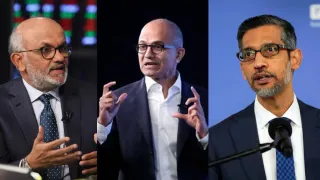
Indian-origin executives have made their mark across the global corporate landscape, leading some of the world's biggest companies through turbulent periods, business transformations and major strategic shifts. From steering technology giants through changing market conditions to rebuilding struggling businesses, several Indian CEOs have played crucial roles in shaping corporate turnarounds. The debate came into spotlight after media reports claimed Indian-origin CEO's could replace NVIDIA CEO Jensen Huang. Among them, Sanjay Mehrotra, SanDisk co-founder among the top contender in the race.
The Indian-origin leadership stories highlight how strategic decision-making, operational discipline and long-term vision can help companies navigate challenging times. Here are some notable instances when Indian CEOs stepped in to lead global companies through critical phases.
Satya Nadella: Microsoft
When Satya Nadella became Microsoft's CEO in February 2014, the technology giant was facing challenges in adapting to the changing technology landscape. Its traditional Windows-centric business model was under pressure as cloud computing and mobile technology gained momentum.
Nadella shifted Microsoft's focus towards cloud computing, artificial intelligence and subscription-based services. Under his leadership, Azure became one of the company's biggest growth engines, while Microsoft strengthened its position in enterprise software and AI.
His transformation helped Microsoft regain its position among the world's most valuable technology companies.
Sundar Pichai: Google
Sundar Pichai took over as Google's CEO in August 2015, at a time when the company was expanding beyond its core search business into artificial intelligence, cloud computing and hardware. Pichai oversaw Google's transition towards an AI-first strategy and strengthened its cloud business. He later became CEO of Alphabet in 2019, taking charge of Google's parent company.
His leadership has been central to Google's efforts to adapt to competition in AI, digital advertising and cloud services.
Shantanu Narayen: Adobe
Shantanu Narayen became Adobe's CEO in December 2007, when the company was known largely for its packaged software products. He led one of the most significant business model transformations in the software industry by shifting Adobe from one-time software licences to a subscription-based cloud model through Creative Cloud.
The transition initially involved considerable uncertainty but eventually helped Adobe build a recurring-revenue business and strengthen its position in digital media and marketing software.
Ajay Banga: Mastercard
Ajay Banga became Mastercard's CEO in 2010, when the global payments industry was undergoing significant changes. He focused on expanding digital payments, financial inclusion and electronic transactions, while strengthening Mastercard's technology and cybersecurity capabilities. Under his leadership, Mastercard expanded beyond traditional card payments into digital payment solutions and data-driven services. Banga later became president of the World Bank in 2023.
Laxman Narasimhan: Starbucks
Laxman Narasimhan took over as Starbucks CEO in March 2023, at a time when the coffee chain was dealing with operational challenges, changing consumer expectations and pressure to improve its store experience. He focused on improving store operations, employee experience and customer service while navigating a challenging global business environment. However, his tenure was short, with Starbucks announcing his departure in August 2024. His stint illustrates the challenges of leading a major global brand through a difficult business phase.
Indra Nooyi: PepsiCo
Indra Nooyi became PepsiCo's CEO in 2006, taking charge of a global food and beverage company facing changing consumer preferences and growing concerns over health and nutrition. She introduced the company's 'Performance with Purpose' strategy, which focused on healthier products, environmental sustainability and long-term business growth. Her leadership helped PepsiCo diversify its portfolio and strengthen its global presence, while navigating changing consumer trends.
You may also like to watch