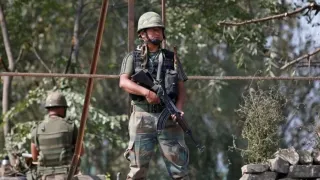
New Delhi: India marks the 10th anniversary of the surgical strikes on Monday, September 28. In the last decade, Pakistan's infiltration bid has changed completely. The 2016 surgical strikes executed by the Indian Army to avenge the Uri attack fundamentally altered Pakistan's cross-border infiltration doctrine, forcing terror networks to abandon traditional Kashmir Valley launchpads and shift operations toward challenging terrains in the Jammu division. An official said that the surgical strikes established a new normal for the Indian Army whereby terrorists would be pushed back frequently. The official said that the "Smart Fence System made it hard for infiltrators to cross borders.
"The strikes also broke Pakistan's assumption of India's strategic restraint," the official said.
The surgical strikes forced a rethink in Pakistan's strategy when it comes to infiltrations. The launchpads, usually set up near the dense forests of Kashmir, were shifted towards the Jammu region. They were set specifically in sectors like Poonch, Rajouri and Kathua.
"These terrains are extremely challenging, and terrorists face a lot of difficulties while trying to infiltrate owing to riverine gaps and broken topography," the official said.
How did the Indian Army limit the infiltration attempts?
An Intelligence Bureau official said that post the surgical strikes, the strategy for countering infiltrations has completely changed. The intensified counter-infiltration grids and the heavy militarisation along the Line of Control (LoC) made it extremely tough for terrorists to enter Jammu and Kashmir, the IB official said.
Smart Fence System
To stop infiltration, about 700 km of the 740 km fence along the LoC have been upgraded to the "Smart Fence System.' The grid now integrates optical, thermal, acoustic and infrared sensors along with AI-driven cameras. This system instantly relays crosshairs and a real-time feed to the command centre when an infiltrator approaches.
Pakistan had also helped terror groups set up oxygen-fitted cross-border tunnels in the Jammu sector. To counter this, seismic ground sensors and hyperspectral imaging were deployed to catch disturbed earth and subterranean vibrations before a tunnel breaches the Indian side.
Another official said that following the surgical strikes and the stepped-up counter-infiltration measures by the Indian Army, the pattern of sending terrorists into Jammu and Kashmir has changed.
Changing pattern
Earlier, a large group of poorly trained terrorists would infiltrate into India in very large numbers. "That pattern has changed now, and Pakistan decided to send highly trained terrorists in smaller numbers. There have been infiltration attempts by terrorists in buddy pairs too in recent years," the official added.
Pakistan has been desperately trying to rebuild its terror network in Jammu and Kashmir. The Indian security forces have dealt a bloody blow to all terror groups operating in Jammu and Kashmir.
In addition to dismantling the overground worker (OWG) network to a large extent, top commanders, their deputies and terrorists on the ground have been eliminated. "Pakistan, which is desperate to piece together a large force of terrorists in Jammu and Kashmir, is unable to do so. This is mainly because the infiltration pattern has changed and terrorists and attempts are being made to push terrorists into J&K in very small numbers," the official said.
Post-surgical strikes
Following the surgical strikes, the Balakot air strike and Operation Sindoor, Pakistan has realised that it cannot afford to carry out audacious or high-profile attacks in India. The terror tactics have changed, and Pakistan has not attempted attacks on the scale of Uri, Pulwama and Pahalgam. Instead, it has increasingly relied on propaganda warfare, disinformation campaigns and targeted ambushes against security convoys and migrant workers.
Further, Pakistan is operating through the Lashkar-e-Taiba and Jaish-e-Mohammed's proxies, the Resistance Front (TRF) and People's Anti-Fascist Front (PAFF). These are made to look like homegrown outfits, and in case of an attack, Pakistan hopes to get away with it using the deniability factor.
While avoiding the blame is one part of the reason to deploy proxies, Pakistan is mindful of India's doctrine change whereby an act of terror would be considered an act of war and not cross-border terror, an official said.
(Note: Except for the headline, this story has not been edited by The Daily Jagran staff. Credit: IANS)
You may also like to watch